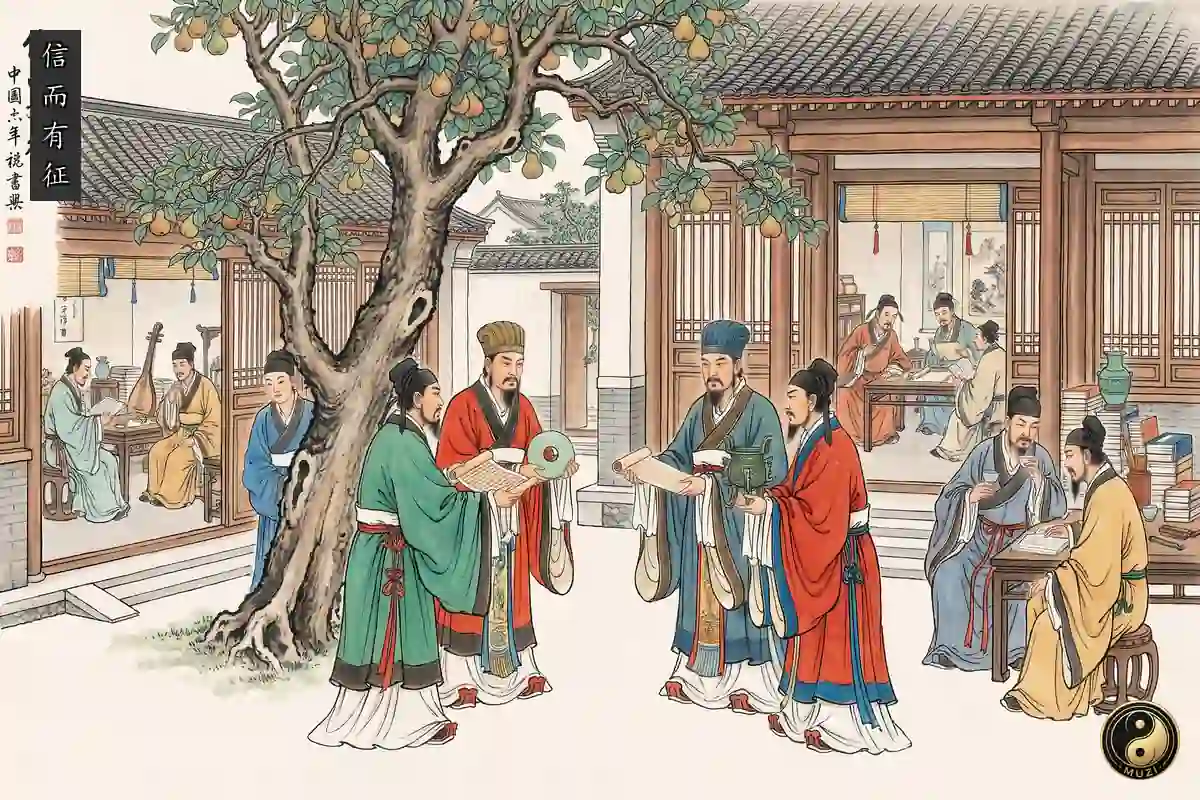
The position of trustworthiness (xin) in the Confucian Five Constants is the one that most resembles infrastructure among the five virtues. If benevolence, righteousness, ritual propriety, and wisdom all draw lines around what kind of being a person ought to become, then trustworthiness draws lines around the most basic dealings between people. It locks every promise, every transaction, and every partnership into an objectively verifiable constraint. It is the social operating layer that allows benevolence, righteousness, propriety and wisdom to be put into practice. The four characters trustworthy and with evidence (xin er you zheng), as the crystallized form of this maxim, must be traced along two lines: one from the Zuo Commentary through the Analects to the Mencius, the layer-by-layer deepening of trustworthiness within pre-Qin Confucianism; another from the Guanzi through Shang Yang to the Han Feizi, the Legalist line of operationalizing trustworthiness as a tool of politics and law. To fully understand the spiritual history behind trustworthy and with evidence, both lines must be followed.
The earliest textual anchor of trustworthy and with evidence is a contrasting passage in the Zuo Commentary, Duke Zhao, Year 8, repeatedly cited by later generations. The original reads: The words of the exemplary person are trustworthy and have evidence, and so resentment stays far from his person. The words of the petty person are presumptuous and without evidence, and so resentment and blame reach him (jun zi zhi yan, xin er you zheng, gu yuan yuan yu qi shen; xiao ren zhi yan, jian er wu zheng, gu yuan jiu ji zhi). It placed trustworthy and with evidence on the side of the exemplary person's speech and presumptuous and without evidence on the side of the petty person's speech, with the word therefore (gu) directly drawing a causal link between whether one's words can earn trust and whether one attracts resentment. The power of this sentence lies in the fact that it defined trustworthiness not merely as a moral proposition but as an objective, empirically verifiable proposition. The two characters with evidence (you zheng) mean having verifiable proof, and their opposite is presumptuous and without evidence (jian er wu zheng), speech that oversteps one's station and cannot be verified. The Jin-dynasty writer Pan Yue wrote in his Rhapsody on Leisurely Living: To claim much, I would not dare; but of being clumsy yet trustworthy with evidence, I may speak (cheng duo ze wu qi gan, yan zhuo xin er you zheng). This represents the standard use of the maxim in literati self-evaluation. The Han-dynasty Cai Yong's Stele of Prince Qiao and Tang-dynasty Yang Jiong's Epitaph for His Cousin Quying both extended this maxim into stele and epitaph literature as a fixed form of praise.
But if one shifts the focus back inside Confucianism, the core position of trustworthiness as a value category was actually not secured until Confucius. In the Analects, when Confucius spoke of trustworthiness, he typically developed it from two directions at once. One direction defined it as the basic ethic of daily interaction. For example, that sentence in the Analects, Wei Zheng chapter, repeatedly cited by later generations: A person without trustworthiness, I do not know how that is possible. A large cart without a yoke-pin, a small cart without a collar-bar, how can it go anywhere? (ren er wu xin, bu zhi qi ke ye. da che wu ni, xiao che wu yue, qi he yi xing zhi zai?). Using the metaphor of carts that cannot move without their connecting pins, this positioned trustworthiness as the necessary condition for a person to function in society. The other direction elevated trustworthiness to the highest level of political governance. In the Analects, Yan Yuan chapter, Zigong asked about governance. Confucius answered: Sufficient food, sufficient arms, and the people's trust (zu shi, zu bing, min xin zhi yi). Zigong asked, If one had to give up one of these three, which should go first? Confucius answered, Give up arms. Zigong asked again, If one had to give up one of the remaining two, which should go first? Confucius answered: Give up food. From ancient times, all have had to die, but without the people's trust, the state cannot stand (qu bing ... qu shi. zi gu jie you si, min wu xin bu li). This placed trustworthiness in the position of what one would sooner give up military and food supplies than lose. This passage was the critical leap by which trustworthiness was elevated from everyday ethic to the highest political value. In the Analects, Xue Er chapter, Master Zeng's I daily examine myself on three counts: In planning for others, have I been disloyal? In dealings with friends, have I been untrustworthy? Have I failed to practice what was transmitted to me? (wu ri san xing wu shen, wei ren mou er bu zhong hu? yu peng you jiao er bu xin hu? chuan bu xi hu?) placed trustworthiness on the daily self-examination checklist of personal cultivation, the tightest formulation of trustworthiness at the level of private ethics.
The one who simultaneously elevated trustworthiness from both the political-operational and the personal-ethical levels to the level of the Way of Heaven was Mencius. In the Mencius, Li Lou, Part 1: Sincerity is the Way of Heaven; thinking about sincerity is the Way of humans. There has never been one who was utterly sincere and yet failed to move others; without sincerity, there has never been one who could move others (cheng zhe, tian zhi dao ye; si cheng zhe, ren zhi dao ye. zhi cheng er bu dong zhe, wei zhi you ye; bu cheng, wei you neng dong zhe ye). This made sincerity (cheng) the essential attribute of Heaven and thinking about sincerity the essential attribute of humans. Here sincerity and trustworthiness were defined by Xu Shen in the Shuowen Jiezi as mutual glosses: sincerity means trustworthiness; trustworthiness means sincerity (cheng, xin ye; xin, cheng ye). So Mencius's sincerity is the Way of Heaven effectively elevated trustworthiness to a cosmological height. Xunzi, in the Against Pretension (Bu Gou) chapter, brought sincerity down to an operational level: For the exemplary person, there is no better way to nurture the heart than through sincerity. When sincerity is achieved, there is nothing else to attend to, only guarding benevolence and practicing righteousness (jun zi yang xin mo shan yu cheng, zhi cheng ze wu ta shi yi, wei ren zhi wei shou, wei yi zhi wei xing). This made sincerity the highest method of nurturing the heart, forming two complementary faces with Mencius's cosmological view of sincerity.
Running parallel to the Confucian line is the pre-Qin Legalist line that operationalized trustworthiness as a tool of politics and law. The earliest instance is the Guanzi, Pivot of Words (Shu Yan) chapter: The former kings valued sincerity and trustworthiness. Sincerity and trustworthiness are the knot that binds all under Heaven (xian wang gui cheng xin. cheng xin zhe, tian xia zhi jie ye). Guan Zhong elevated trustworthiness from a personal quality to a mechanism for binding all under Heaven, the earliest source of the later idea of governing the state through trustworthiness. By the Warring States period and Shang Yang's reforms, the famous establishing trust by means of a wooden post (li mu wei xin) story brought trustworthiness from the conceptual level down to an operable legal tool. Shang Yang erected a thirty-foot wooden post at the south gate of the Qin capital Xianyang and announced: Whoever can move this post to the north gate will receive ten pieces of gold. No one responded, so he raised the reward to fifty. Finally someone did it, and Shang Yang immediately paid the full fifty pieces, using one risk-free reward fulfillment to build in the minds of the Qin populace the cognitive foundation that words will always be followed by deeds. This paved the way for the nationwide implementation of his reforms (Records of the Grand Historian, Biography of the Lord of Shang). This event became the standard example of establishing a state through trustworthiness. Paired alongside it as a negative example is the beacon fire trick on the feudal lords (feng huo xi zhu hou) recorded in the Records of the Grand Historian, Basic Annals of Zhou: King You of Zhou lit the border alarm beacons to amuse his consort Bao Si, causing the feudal lords to rush to the capital for nothing. A few years later, when the Quanrong actually invaded and the beacons were lit again, not a single lord responded, and the royal house fell. The two stories placed together left posterity a pair of contrasting political parables about trustworthiness.
The one who further compressed trustworthiness from the political-operational level into a technique of governance was the Han Feizi. In the Outer Collection of Sayings, Upper Left chapter, Han Fei used when small trust is sincere, then great trust is established (xiao xin cheng ze da xin li) as the core of Legalist governing technique. Keep faith in small matters, and great trust will be built. The logic behind this sentence is the accumulability of trustworthiness. Unlike the Confucians, who treated trustworthiness as a character trait of the exemplary person, the Legalists treated it as an operable lever by which the ruler builds credibility in great affairs by keeping promises in small ones. This was the critical leap in the instrumentalization of trustworthiness. By the Han dynasty, Dong Zhongshu in his Three Memorials to the Heavenly Throne and his Luxuriant Dew of the Spring and Autumn Annals formally listed trustworthiness as one of the Five Constants alongside benevolence, righteousness, propriety and wisdom, elevating it from a scattered expression among the five virtues into a complete five-dimensional system. From that point on, the Five Constants entered the ethical bedrock of Chinese civilization as a fixed phrase, in use for two thousand years to the present day.
The internal logic of this entire path of trustworthiness, from the Zuo Commentary, Duke Zhao, Year 8, the words of the exemplary person are trustworthy and have evidence. The Analects, Wei Zheng, a person without trustworthiness, I do not know how that is possible with the metaphor of carts without pins. The Analects, Yan Yuan, Zigong's question on governance and from ancient times all have had to die, but without the people's trust the state cannot stand at the highest political level. The Mencius, Li Lou, Part 1, sincerity is the Way of Heaven elevating it to the cosmic plane. The Guanzi, Pivot of Words, the former kings valued sincerity and trustworthiness as the Legalist operational source. The Records of the Grand Historian, Biography of the Lord of Shang, the establishing trust by means of a wooden post political example and the beacon fire trick counter-example, to the Han Feizi's when small trust is sincere, then great trust is established as governing technique, and to Dong Zhongshu incorporating trustworthiness into the Five Constants, has always been one and the same: translate abstract promises into objective credit records that can be verified, held accountable, and accumulated. This is why trustworthy and with evidence endures as an imperishable maxim in the Chinese language, gathering the entire lineage from the Zuo Commentary through the Analects, Mencius, Guanzi, Shang Yang, Han Feizi, and Dong Zhongshu into the simplest possible four characters.