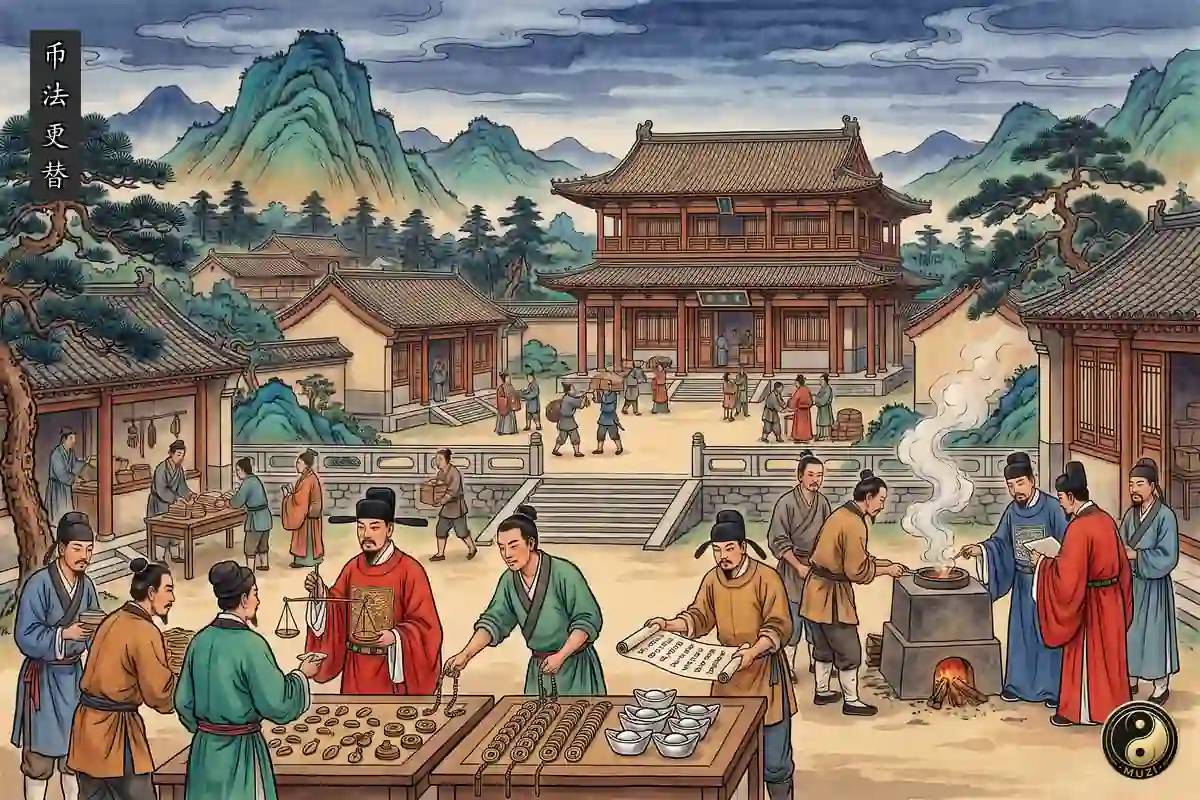
On the beginning of money the historians wrote with care. The "Treatise on the Balanced Standard" in the Records of the Grand Historian (Shiji) says: "When the roads of exchange among farmers, craftsmen and merchants opened, money in the form of tortoise shell, cowries, gold, coins, knives and cloth arose. Its source is long ago, before Gaoxin, and no account of it can be had." A page of Notes on Marco Polo in the Toyo Bunko rare-book archive says that many cowries were unearthed at Yinxu, together with imitations made of mussel shell, and its writer takes this to support the view that the Shang already had shell money (the page names Andersson); the writer also admits that what is known of early shell money is scanty, and that the word for "shell" was a general name for all shells, which made matters more uncertain.
The script too keeps a trace of the shell. The same page points out that the character for "shell" is the radical of most characters meaning precious, trade and wealth, and that down to today the word for "treasure" still carries it. The writer of the page calls the character form a strong argument for shell money under the Shang; whether the shell was money in the Shang is recorded here as that page's view, not as settled.
After the Qin, money had a form fixed by the state. The Treatise on the Balanced Standard writes: "The money of Yu and Xia took gold in three grades, yellow, white or red; or coins, or cloth, or knives, or tortoise shell and cowries. When it came to the Qin, the money of the whole land was made two grades: gold was named by the yi and was the upper money; bronze coin was marked banliang, its weight as its inscription, the lower money. But pearls, jade, tortoise shell and cowries, silver and tin, were used for ornaments and treasures and were not money." Tortoise shell and cowries are plainly said no longer to be money. This chapter gives no year for the Qin's unification.
The Han adjusted repeatedly. The book says that early in the Han, "as the Qin coin was heavy and hard to use, the people were ordered to cast coin"; under Emperor Wen "four-zhu coins were cast anew, their inscription 'banliang', and the people were allowed to cast coin freely", with the result that "the coin of the Wu and Deng families spread through the realm, and the prohibition on casting arose"; under Emperor Wu, "a square chi of white deer skin" was made into skin money, and "white metal was made of silver and tin", and later, "the officials said the three-zhu coin was light and easy to cheat, and asked that the commanderies and kingdoms cast five-zhu coin, with a raised rim so that the metal could not be filed away". The page gives no year for the five-zhu coin.
In the Song paper appeared. The Songshi (History of the Song), in its Treatise on Food and Money, writes: "In the reign of Zhenzong, Zhang Yong, governing Shu, was troubled that the iron coin of the Shu people was heavy and inconvenient for trade; he set up a certificate method, one paper for one string, to be exchanged after a period of three years." It was at first run by sixteen wealthy households, later "the transport commissioners Xue Tian and Zhang Ruogu asked that a jiaozi office be set up in Yizhou to control issue and withdrawal, with a ban on private forgery", and Emperor Renzong followed the proposal. The treatise also records the fault: around the fifth year of Xining (1072), "jiaozi were issued in great number while coin was short, so their price fell too low". These sentences give no year for the beginning of jiaozi.
The Ming pushed paper money across the country, then saw it fail. The History of the Ming, in its Treatise on Food and Money, says paper money "began with the flying cash of the Tang, the exchange notes of the Song and the circulating notes of the Jin; in the Yuan paper was used throughout and coin almost fell out of use". In the seventh year of Hongwu "the emperor set up an office of treasure-note supervision; the next year the Secretariat was ordered to make the Great Ming treasure notes and put them into circulation among the people", fixing that "each note of one string equals a thousand wen of coin, or one liang of silver; four strings equal one liang of gold. The people are forbidden to trade in gold, silver and goods." Later it records: "By the early Xuande years, a shi of rice cost fifty strings of notes, and the ban on trading in cloth, silk, rice and wheat was relaxed." Only cloth, silk, rice and wheat were freed; the ban on silver remained. The seventh year of Hongwu is 1374, the eighth 1375.
Silver took over. The History of the Ming says: "When Emperor Yingzong came to the throne, there was an order to collect taxes in rice and wheat commuted to silver, and so the paper-note payers were reduced", and "the ban on silver was relaxed. Everyone, in court and country, used silver, and for small sums coin"; the same passage goes on that in Zhengtong "year 13 the ban was proclaimed again", and that "in the Tianshun years the ban was first relaxed". Under Xianzong the treatise writes that "Xianzong ordered that duties at court and in the provinces be taken in both coin and notes", and that "at that time a string of notes could not buy a single wen of coin". The salt chapter of the same Treatise on Food and Money also records that in the fifth year of Hongzhi (1492) merchants began paying silver to the salt transport office. In the chapter on taxes and service it says: "The Single Whip method gathers together a prefecture's or county's taxes and labour service, measuring by land and counting the adult men, and has the grain and labour all paid to the government", "all collected as silver by the mu and handled by the officials, hence the name Single Whip", and that "in the Jiajing years it was tried and dropped again and again, until the ninth year of Wanli when it was put in force everywhere". The ninth year of Wanli is 1581. This page does not mention Zhang Juzheng by name.
In these records, a few of the changes come with a stated cause, and the causes are not the same. The early Han found the Qin coin "heavy and hard to use", and under Emperor Wen the elm-pod coins were "more and light", so coin was recast; the Shu people found iron coin heavy, hence jiaozi; when Emperor Renzong asked why the notes did not circulate, Xia Yuanji said that "if notes are many they are light, if few they are heavy"; and by the early Xuande years a shi of rice took fifty strings of notes, and the court relaxed the ban on trading in cloth, silk, rice and wheat. For other changes, such as the Qin's two grades of money, Emperor Wu's skin money and white metal, the Hongwu treasure notes and the Single Whip, the pages cited give no cause.
Currency Evolution is linked to several other canons. Jiaozi Banknotes covers paper money and salt certificates, and the jiaozi and treasure notes in the Songshi and Mingshi above are its subject. Salt & Transit Monopolies covers salt revenue, and the Mingshi records that kaizhong merchants came to pay silver, so silver entered the salt trade. Chinese Characters covers the script, and the Toyo Bunko page points out that the shell character stands for wealth and trade in many characters. Records of the Grand Historian covers that history, and the Treatise on the Balanced Standard is the chapter of the Shiji on coin and state finance. Merchant Guild Commerce covers merchants, and the Treatise says: "Merchants, because of the changes in money, piled up goods in pursuit of profit."
In these books currency is not a separate history of coins but bound up with taxes, labour service and salt revenue. The Shiji wrote money into history, the Mingshi wrote the replacement of notes by silver into government, and the change of taxes and service to silver was then fixed in the Single Whip method.
Cowries, gold, bronze coin, iron coin, paper notes and silver: these books record one change after another. A few times the books set down the trouble of the day: "the Qin coin was heavy and hard to use", "troubled that the iron coin of the Shu people was heavy", "if notes are many they are light, if few they are heavy". By Xianzong's time "a string of notes could not buy a single wen of coin"; silver, from Yingzong's commuting of rice and wheat to silver, through the silver payments of Hongzhi 5, to the Single Whip put fully in force in Wanli 9, entered taxes and the salt rules step by step. Of the beginning of money, the Grand Historian says only that "no account of it can be had"; this thread runs from the Treatise on the Balanced Standard to the Mingshi.
Currency Evolution is the class in the chapter on Commerce on the succession of money from the Shang to today: from the cowries found at Shang sites, to the round, square-holed banliang coin after the Qin unification, to the payment mainly in silver of the Ming and Qing. The right to cast coin and the standard of its fineness were held by the successive dynasties.
 Literature
 People
 Zhang Juzheng
 Xue Tian
 History
 Single Whip Law Reform