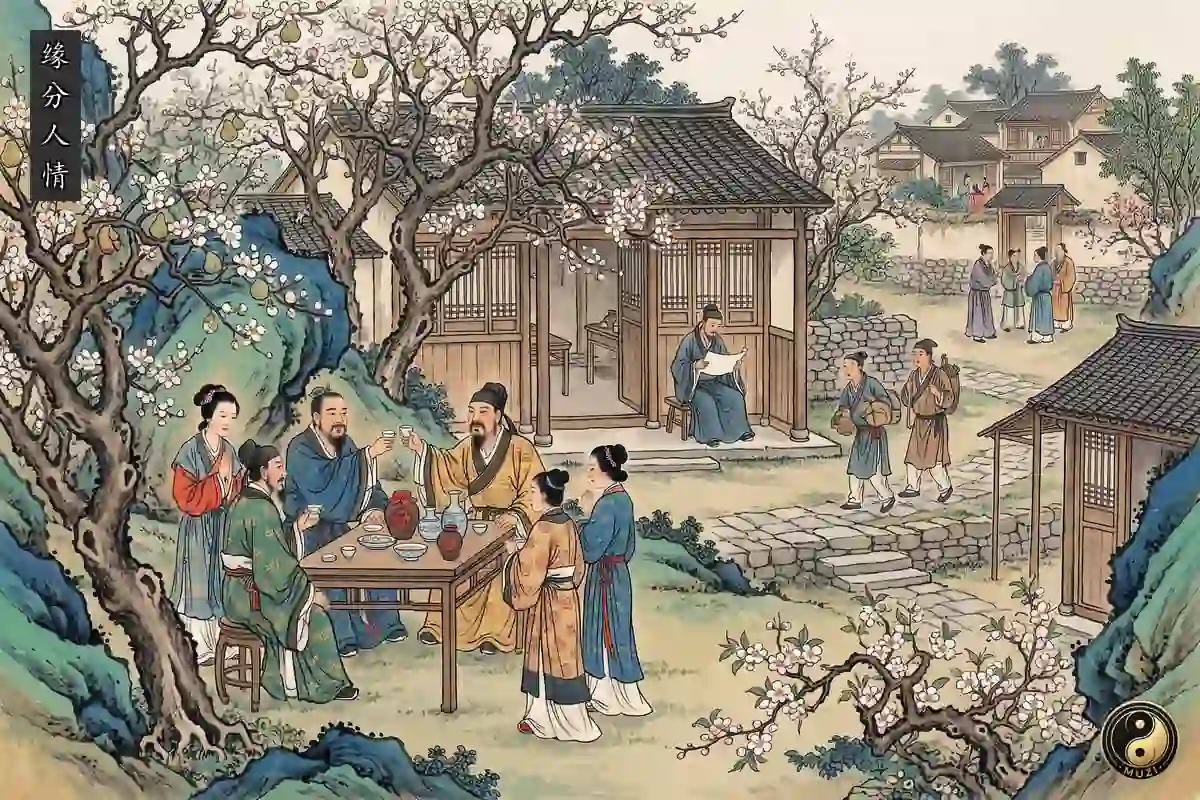
The phrase "ritual values coming and going" is found in the first part of the chapter Qu Li of the Book of Rites. The passage first says "the highest regard is for virtue; next comes attending to giving and repaying", and goes on: "Ritual values coming and going. To go without coming is not ritual; to come without going is not ritual either. When people have ritual, there is peace." This was a teaching of ritual learning from the Warring States onward, later taken into the Book of Rites, and it gave the ethic of reciprocal favour its formulation. The older Book of Songs already carries a similar sense: each of the three stanzas of "The Quince" in the Odes of Wei ends with "not as repayment, but to be friends for ever", so that a return gift is not meant to settle an account but to keep a lasting friendship; and "Yi" in the Greater Odes has "throw me a peach, and I repay you with a plum". In the Xue Er chapter of the Analects, Master Zeng asks himself each day "in dealing with my friends, have I failed to keep faith?", and Zixia says "in dealing with friends, one keeps one's word". On how friends and neighbours should treat each other outside the bonds of blood, the pre-Qin classics offer three threads: ritual, repayment and trust.
The "yuan" of yuanfen has another history. A study of yuanfen published in the Vienna Journal of East Asian Studies in 2015 cites earlier research to the effect that the word yinyuan already existed in the Han, meaning a basis or ground; that after Buddhism arrived it was used to translate the "twelve links of dependent origination", with "yin" as the primary cause and "yuan" as the conditions that help bring about the result; that from the Tang onward such Buddhist ideas gradually became native ones; and that the "fen" of yuanfen was probably taken from dingfen, "fixed lot", to stress the sense of destiny. According to volume two of the Liang Biographies of Eminent Monks, Kumarajiva reached Chang'an in the twelfth month of the third year of Hongshi (early 402 by conversion), and "the scriptures and treatises he produced came to more than three hundred scrolls"; the Book of Jin records that Yao Xing had more than eight hundred monks, among them Sengrui and Sengzhao, receive the teaching from him. His translation of the Lotus Sutra says in the chapter on Skilful Means: "the World-Honoured Buddhas appear in the world solely because of one great cause." As these translations spread, the Buddhist teaching of causes and conditions became widely known.
In the Northern Song the ethic of reciprocity took the form of a written village compact. The Biography of Lü Dafang in the History of Song says that the Lü brothers lived together, discussing the Way and examining ritual, so that "in Guanzhong those who spoke of ritual learning looked to the Lü family", and records: "They once drew up a Compact, which said: all who join the compact shall encourage one another in virtue and work, correct one another's faults, deal with one another by ritual and custom, and help one another in trouble; good deeds are written in the register, faults and breaches of the compact are written too; after three offences a penalty is imposed, and those who do not reform are cut off." Liu Xuezhi, a professor at Shaanxi Normal University, dates the making of the Lü Family Compact to the ninth year of Xining (1076) and ascribes it to the brothers Lü Dazhong, Lü Dajun, Lü Dalin and Lü Dafang of Lantian; the History of Song places the passage in the biography of Lü Dafang. An introductory article carried on the same page says that it was not a decree proclaimed from above but an agreement entered into freely, "those who come are not refused, those who leave are not pursued"; that in the Southern Song Zhu Xi compiled a revised version of the Lü Family Compact, and that in the Ming Wang Yangming drew on it to put the Southern Gan Compact into practice in Jiangxi, "after which it spread north and south". Coming and going, and helping one another, thus became more than personal courtesy: good deeds and faults were entered in a register, three breaches brought a penalty, and those who kept offending were put out of the compact.
In the twentieth century the give and take of favour became a subject of sociological study, and these analyses are modern accounts. The scholar Shen Yi (Open Times, 2022, no. 4) notes that the "differential mode of association" proposed by Fei Xiaotong in 1947, "although lacking a precise scientific definition, has increasingly become an important concept in the study of the Chinese people and Chinese society", and that Hwang Kwang-kuo's model of "favour and face" is also a reading of it. Citing the work of Yang Lien-sheng (1957) and others, Shen Yi says that a person who has received a favour may later face the pressure of the ethic of repaying kindness, and the reproach of his own conscience, even if public rules kept him from repaying his benefactor; he also says that in exchanges of favour people generally "take a small loss" so that the other side "owes them a favour". Yuanfen has been looked at afresh as well. The study mentioned above, drawing together surveys by Yang Kuo-shu and others, says that belief in yuanfen is still high, but beliefs about its supernatural origins have receded; yuanfen was once used to account for relations seen as predestined, such as those of kinship or a shared place, and is now used more for relations that cannot be explained by family ties or other obvious causes.
Reciprocity is bound up with three other canons. With Rituals: "ritual values coming and going" itself comes from the Qu Li chapter of the Book of Rites, which judges both going without coming and coming without going to be "not ritual"; the History of Song also sets the compact in the passage on the Lü brothers' study of ritual, and "dealing with one another by ritual and custom" is one of its four articles. With Trust: when Master Zeng and Zixia speak of friendship, both come to rest on keeping faith, and a relationship of give and take is held together by keeping one's word. With Kinship: the compact was addressed to "all who join the compact", joining was voluntary, and mutual care did not depend on belonging to the same clan; the surveys cited above also show that yuanfen is now used more for relations outside family ties.
The Qu Li judged "to come without going" to be against ritual, and the Lü Family Compact wrote "help one another in trouble" into a register and a scale of penalties: reciprocity was first a demand of ritual and then an agreement kept in common by a village, which, revised by Zhu Xi and put into practice by Wang Yangming, "spread north and south". Kumarajiva's translations spread the teaching of causes and conditions, and in time yuanfen became one way in which people explained their meetings and ties. In the twentieth century scholars such as Fei Xiaotong, Hwang Kwang-kuo and Yang Kuo-shu took up differential association, favour, face and yuanfen to study Chinese society, and the ethic passed from the classics and the village compacts into modern scholarly debate.
Reciprocity is the class in the chapter on Values on how people deal with one another in a society of acquaintances. Favour, face and yuanfen, the sense of a bond fated between people, are the habits of mind by which friends and neighbours repay one another, and beyond ties of blood they form bonds of mutual care.
 Literature
 Classic of Poetry
 Book of Rites
 Book of Jin
 People
 Zhu Xi
 Zengzi
 Kumarajiva (Jiumoluoshi)