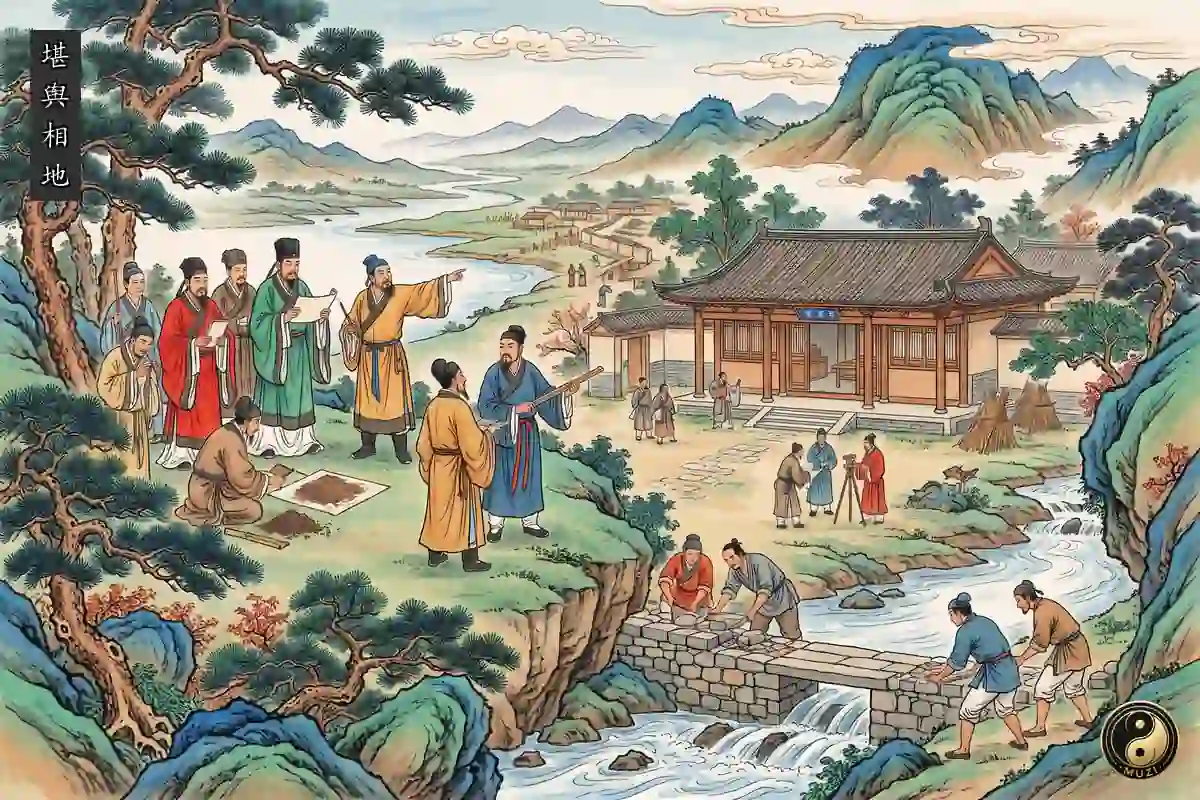
*Kanyu xiangdi* (site assessment through landscape inspection) is a systematized method of architectural site selection and spatial planning in ancient China based on geographic-environmental survey. Its core technical principles are *cangfeng juqi* (sheltering from wind and gathering vital breath) and *fuyin baoyang* (backing onto shade, embracing sunlight): positioning a site with mountains behind to block the bitter north winds of winter (sheltering from wind), facing running water for convenient daily access and drainage (gathering vital breath), and opening the front toward the sun to maximize daylight and cultivable area. The *Shijing, Daya, Gongliu* preserves the earliest written record of kanyu practice. When the Zhou ancestor Gong Liu chose the land of Bin as his capital, *ji jing nai gang, xiang qi yinyang, guan qi liuquan* (he surveyed the sun's shadow from the ridge, assessed its yin and yang, and inspected its flowing springs): he climbed the ridge to observe shadow direction for orientation, and walked to the streams to evaluate water volume and quality. These three phrases, *xiang qi yinyang,* may be regarded as the oldest textual record of kanyu.
Kanyu practitioners used the *luopan* (compass), a comprehensive surveying instrument integrating a magnetic needle and precisely graduated directional markings, to determine a building's orientation and the full directional relationships of surrounding mountains and waterways. The compass face bore multiple concentric rings: the innermost was the *tianchi* (heaven pool, containing the magnetic needle at center), the middle ring displayed the twenty-four mountain directions (dividing the four cardinal directions into six sub-directions each, yielding twenty-four finer directional points), and the outer rings mapped correspondences between the sixty-four hexagrams and the twenty-eight lunar mansions. A kanyu master aligned the compass center with the building's orientation baseline, read the precise corresponding point on the twenty-four mountain ring, and then, according to the two core analytical schools, *xingluan* (landscape form: the physical shapes and courses of mountains and waterways) and *liqi* (pattern and vital force: the auspicious or inauspicious properties of time and direction), rendered a comprehensive judgment on the site's overall suitability.
Kanyu practice reached the zenith of both theory and application during the Ming and Qing dynasties. The Ming dynasty Forbidden City in Beijing and the Ming Thirteen Tombs both underwent rigorous kanyu surveys and multiple rounds of expert deliberation regarding geographic site selection and building orientation. Behind the Forbidden City, Jingshan (Prospect Hill) is an artificially constructed elevation whose function was to provide a natural backing mountain to the north (sheltering from wind) but also, through its massive bulk, to suppress the residual imperial aura of the preceding dynasty's capital (Yuan Dadu). The Qing emperors Kangxi and Qianlong both personally participated in and ultimately adopted kanyu assessments during the site selection for the Chengde Mountain Resort and the Eight Outer Temples. In the orientation of the main hall doorway in an ordinary Beijing courtyard house, the complete layout of rockeries and ponds in a Jiangnan garden, and even the doorway orientation of an ordinary farmhouse's main room, the most basic environmental principles of kanyu are physically imprinted in the fabric of daily life.
The internal logic of *kanyu xiangdi* lies in systematizing all of humanity's most primal and inescapable instinctive needs regarding the dwelling environment, avoiding cold winds, staying close to water, and facing the sun, into an operable, transmissible, and *luopan*-calibrated body of holistic practical knowledge. The total geographic-environmental wisdom summarized in the eight characters *cangfeng juqi, fuyin baoyang* is, in essence, a proto-version of architectural environmental science, assembled through millennia of empirical accumulation in a pre-scientific era when humanity had no knowledge of geophysics or meteorology. This is precisely why kanyu has permeated Chinese system for three thousand years, from Gong Liu's survey of the Zhou plain to the compass-guided orientation of the Forbidden City, persisting as an environmental assessment discourse that can never be entirely dismissed.