The Eastern Han court treated earthquakes as events that had to be recorded and answered. The Treatise on the Five Phases in the Book of the Later Han lists earthquakes year by year and often attaches the politics of the time, for example the earthquake in the capital on the jihai day of the fourth month of the second Yangjia year, followed by "at this time the title of Lady Song E was raised to Princess of Shanyang". The Annals of Emperor Shun record the court's measures: in the third Yongjian year, the first month, an earthquake in the capital and a cleft in the ground at Hanyang; an edict ordered the injury verified, gave two thousand cash to each person of seven years or older, and ordered "no collecting this year's land tax and poll levy at Hanyang". After the capital earthquake of the second Yangjia year, the edict of the fifth month said: "Anomalies are not made for nothing; each must answer something; let each of you speak out frankly on its cause, hiding nothing." The officer who kept track of anomalies was the Grand Astrologer; the Treatise on the Hundred Offices says that he "was in charge of heaven's times and the stars' reckonings; at the year's end he presented the new year's calendar", and "when the state had omens or anomalies, he was in charge of recording them". Calendar-making and the recording of disasters belonged to this one office, and the new year's calendar treated in the entry on Lunisolar Calendar also came from here.
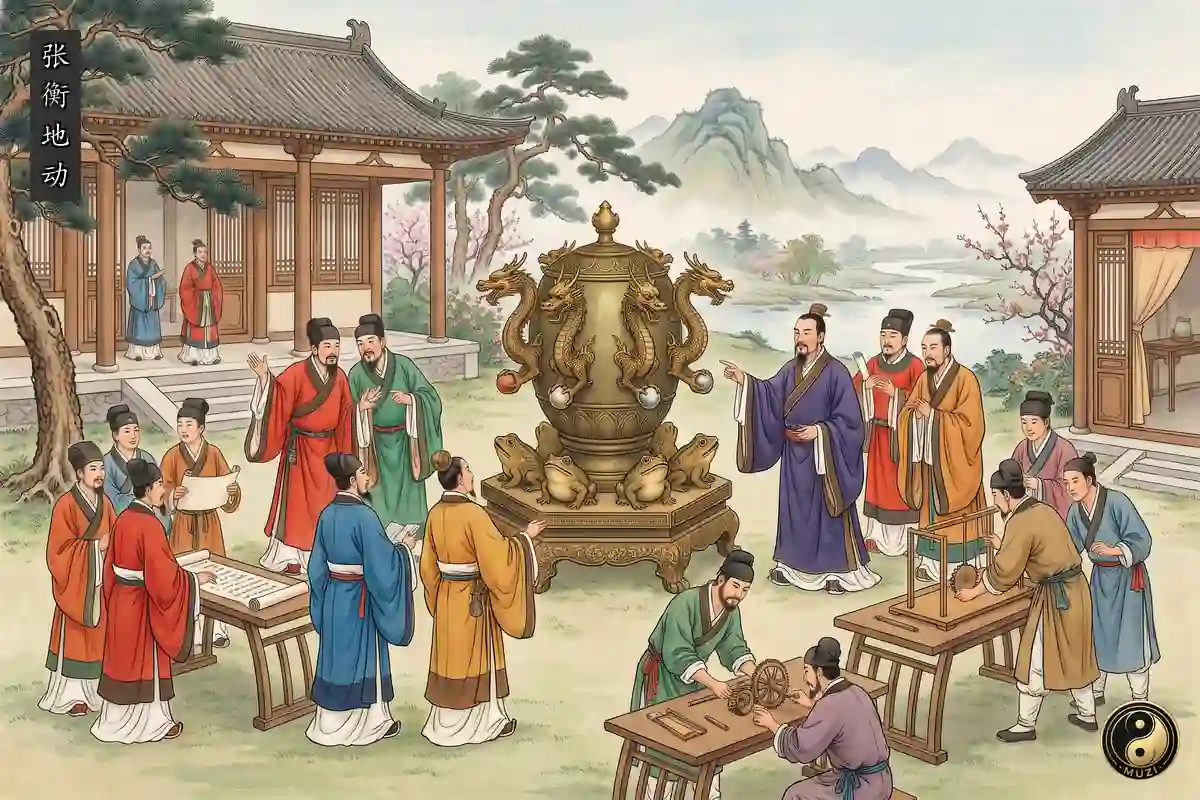
Zhang Heng held this office. The Biography of Zhang Heng in the Book of the Later Han says that he "was skilled in mechanisms and above all devoted to astronomy, yin-yang and calendrical reckoning", and that after becoming Grand Astrologer he "made the armillary sphere and wrote the Spiritual Constitution and the Reckoning Net". The Annals of Emperor Shun record that in the first Yangjia year (132), in the seventh month, "the official historians first made the wind-sensing earthquake bronze instrument", with the gloss "at that time Zhang Heng was Grand Astrologer and made it"; the biography of Zhang Heng also says that he built it: "he made again the wind-sensing seismoscope, cast of fine bronze, eight feet across, with a domed lid, shaped like a wine vessel"; "inside is a central pillar with eight tracks off to the sides, with catches and triggers. Outside are eight dragons, each holding a bronze ball in its mouth, and beneath each a toad with mouth open to receive it"; when the earth shook, "the vessel stirred the dragons, the trigger fired, a ball dropped and the toad held it", and "although one dragon's trigger fired, the other seven heads did not move; following the direction, one knew where the quake was". The biography adds that once "a dragon's trigger fired but no one felt the earth move; the scholars of the capital all wondered at its failure; some days later a courier arrived, and indeed there had been an earthquake in Longxi, and all submitted to its wonder". The biography gives no year for this. The Annals of Emperor Shun, for the second month of the third Yonghe year (138), record "earthquake in the capital and in Jincheng and Longxi"; if the test in the biography were placed at that event, it would not fit "no one felt the earth move", since that entry also says the capital shook; so this text makes no judgement on the year.
The instrument's effect is stated in one line by the history: "From then on, the official historians were ordered to record the direction from which an earthquake came." From that time the historians had to note which direction an earthquake came from. It showed direction after an earthquake, so that the capital knew before the courier arrived that a distant place had shaken, and its credibility was established before the scholars of the capital by comparison with the courier days later. The Book of the Later Han calls it "tested against events, matching like a tally of a god", which is the historian's own judgement. As for the relief after the earthquake of the third Yonghe year, the Annals of Emperor Shun are specific: a Grand Master of the Palace was sent to Jincheng and Longxi, and among those crushed to death, each aged seven or over was granted two thousand cash, and "this year's land tax was remitted". The seismoscope added to the record of anomalies one item that could be checked, the direction.
The reading of earthquakes as omens persisted alongside Zhang Heng's instrument. The Treatise on the Five Phases cites the Chunqiu Han hanzi: "When the female ruler is strong and the minister commands, the earth splits, the border quakes, the mountains fall", and links the earthquake in thirteen commanderies and kingdoms in the sixth month of the fourth Yongyuan year to Empress Dowager Dou's regency and Dou Xian's monopoly of power. Zhang Heng himself in a memorial urged "collecting and storing the apocryphal texts, and banning them all", and also mentioned an anomaly such as "the earthquake and cracking of the ground in the capital the year before last". The Yangjia 2 earthquake entry cited above falls in the year after the instrument was made, and it still carries the note on Song E's title; the framework for explaining anomalies treated in the entry on Yin-Yang & Five Elements was not set aside for a bronze vessel, and what changed was the detail recorded. Zhang Heng was also the maker of the armillary sphere treated in the entry on Armillary Spheres: Li Xian's commentary on his biography quotes Cai Yong, from the Memorials of Eminent Han Officials, as saying there were three schools of the heavens, Zhoubi, Xuanye and Huntian, and "only the Huntian is near the truth; the bronze instrument used by the historians on the observatory follows its method". The Treatise on Pitch-Pipes and the Calendar in the Book of Sui lists him among those who set new values for pi: "from Liu Xin, Zhang Heng, Liu Hui, Wang Fan and Pi Yanzong on, each set a new value", a list that also runs to Liu Hui, treated in the entry on Nine Chapters.
What people know of the seismoscope today rests mainly on these passages and on later reconstruction. A piece by the Guangdong Communist Youth League carried on The Paper says that the instrument in textbooks is a model that Wang Zhenduo reconstructed from the histories; he drew a "suspended pendulum" design in 1936, and in 1951 turned to the "upright rod principle" and made a 1:10 wooden model, which was entered in textbooks and which the China Earthquake Administration used as its emblem; some scholars hold that the principle cannot work. Liu Jing, a researcher at the Institute of Tibetan Plateau Research, Chinese Academy of Sciences, told the Science and Technology Daily in 2010 that monitoring earthquakes with the seismoscope is feasible in principle, its function "beyond doubt", and that its role is to monitor, not to predict; the report also states that no reconstruction yet matches the records and also monitors earthquakes. According to the same report, the Henan Museum made one copy in 2005 at a cost of several hundred thousand yuan; Feng Rui, who took part in the reconstruction, had said earlier that monitoring real earthquakes would require foundations and other facilities at great cost. The Youth League article, posted in October 2018, also reports the reply of the People's Education Press: the content on Zhang Heng and the seismoscope had not disappeared from the standard textbooks, only been rearranged.
A few lines in the histories are the main evidence for the instrument: it was made by the Grand Astrologer, who kept the calendar and the records of anomalies, and by the same man who made the armillary sphere; it gave earthquakes a direction that could be recorded, so that from then on historians noted which side an earthquake came from, while the Treatise on the Five Phases went on recording earthquakes together with the politics of the court. Later people have no original; reconstructed models, diagrams in textbooks and disputes about the principle all start from those few lines.
Zhang Heng Seismoscope is the class in the chapter on Sciences on the seismoscope made by Zhang Heng of the Eastern Han. Built at Luoyang, it sensed the direction of a distant earthquake through a central pillar and a mechanism of eight dragons.
 Literature
 Book of the Later Han
 People
 Wang Zhen
 Liu Xin
 Zhang Heng
 Cai Yong
 Treasures
 Atlas
 Guangdong