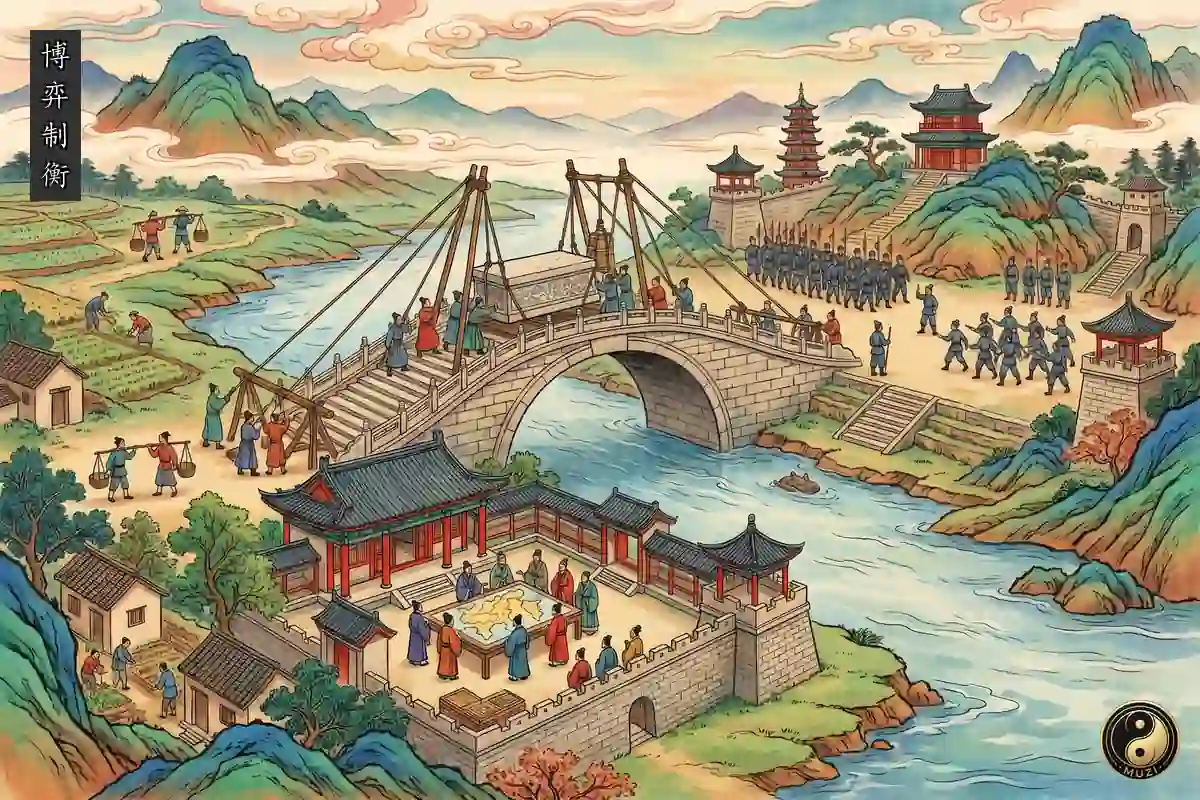
How should the weak deal with the strong? People of the Warring States thought this through in fine detail. The weight of Balance of Power lies here: it puts the question "what to do when strength falls short" both into a single horse race and into the pacts between states, and turns it into reasoning that can be argued over and tested.
The horse-race story appears in the Records of the Grand Historian, in the Biography of Sunzi and Wu Qi. Sun Bin was a later descendant of Sun Wu. Pang Juan had his feet cut off and his face tattooed; an envoy of Qi later carried him secretly to Qi, where he became a retainer of the general Tian Ji. Tian Ji often raced horses with the princes of Qi for high stakes. Sun Bin saw that their horses were not far apart in speed and fell into three grades, upper, middle and lower, and said: "Match your lower horse against their upper horse, your upper horse against their middle horse, and your middle horse against their lower horse." When the three races were done, Tian Ji had "lost once and won twice" and took the thousand pieces of gold. Later, when Wei attacked Zhao, Sun Bin urged Tian Ji to march straight on the Wei capital Daliang and "strike at the hollow place and hit the weak spot, so that the situation forces them to let go." The Wei army did withdraw from Handan and was beaten by Qi at Guiling.
The contests among states were called, in the histories, the "vertical" and the "horizontal." The Biography of Su Qin in the Records of the Grand Historian tells how Su Qin urged the King of Zhao to unite the states and fix an agreement: "if any lord fails to keep the pact, the armies of five states shall attack him together," so that "with the six states joined to keep Qin at bay, Qin's armored troops will never dare march out of Hangu Pass to harm the east of the mountains." Zhang Yi spoke the other way. He told the King of Wei, "In my plan for Your Majesty, nothing equals serving Qin"; he told the King of Han, "Serve Qin first and you are safe; do not serve Qin and you are in danger"; and he said that "the men of the vertical alliance speak much in grand phrases and can seldom be trusted." One side joined weak states against a strong one, the other had each state lean on the strong one. Each method had its persuaders, and each had its reasons.
The stories of these two persuaders are not firm. The Paper interviewed Cai Yunzhang (adviser to the Pre-Qin History Society of China and researcher at the Luoyang Institute of Cultural Relics and Archaeology). The editor's note to the interview says that the books of the "twelve schools of the vertical and horizontal" listed in the Treatise on Literature of the Book of Han were lost long ago, so later readers know the strategists mainly through the Records of the Grand Historian and the Intrigues of the Warring States; in 1973 a silk text, Letters of the Warring States Strategists, came out of the Han tomb at Mawangdui in Changsha, in which "sixteen chapters of Su Qin's letters and persuasions were found," fourteen of them texts that "even Sima Qian had not seen." In Cai's own words, of the silk text's "27 chapters, 16" are "lost texts long out of circulation"; he holds that Su Qin was roughly a generation younger than Zhang Yi, and not the contemporary rival the Records describe. That is his judgment; it is recorded here without a ruling.
The effect of these methods on history is plain from Qin's side. Fan Ju told King Zhao of Qin: "Your Majesty would do better to befriend the distant and attack the near; every inch you gain is your inch, every foot your foot." Li Si wrote in a memorial: "King Hui used Zhang Yi's scheme, took the lands of the Three Rivers, annexed Ba and Shu in the west, took Shang Commandery in the north and Hanzhong in the south, enclosed the nine tribes of the Yi, held Yan and Ying in check, held the strong pass of Chenggao in the east, and carved out fertile land, and so broke up the alliance of the six states and made them face west to serve Qin." Jia Yi, in "The Faults of Qin," shows the other side: the lords "joined in alliance and became one"; among the men of the six states there were "such as Ning Yue, Xu Shang, Su Qin and Du He who planned for them," and "men like Wu Qi, Sun Bin, Dai Tuo, Ni Liang, Wang Liao, Tian Ji, Lian Po and Zhao She who commanded their troops." The same pacts are the six states pulling together in Jia Yi's pages, and in Li Si's they are broken up by Zhang Yi.
Later readers did not agree on these strategists. Jingchun said that Gongsun Yan and Zhang Yi were surely great men, since "when they were angry the lords feared, and when they lived at peace the world was quiet"; Mencius answered: "To take obedience as the right is the way of a concubine." The Treatise on Literature says the vertical and horizontal school came from "the office of the envoy," that its strength lay in "weighing matters and acting as fits, receiving a commission but not the words to be said," and that "when wicked men practise it, they cheat and abandon good faith." At the end of Su Qin's biography Sima Qian writes: "Su Qin rose from the village lanes and joined six states in the vertical alliance; his wit was beyond the common." Cai Yunzhang quotes Liu Xiang's Preface to the Intrigues of the Warring States: "Su Qin made the vertical, Zhang Yi the horizontal; if horizontal, Qin became emperor; if vertical, Chu became king; the state where they stood became weighty, the state they left became light." He adds that Zhu Xi in his commentary on Mencius and Song Lian of the Ming both disparaged the school, and that after Emperor Wu of Han the climate of honoring worthy men faded, so a body of strategists like this became hard to find again.
It is tied to other canons in several places. Cai Yunzhang says the Warring States part of the Records of the Grand Historian draws on tales of "expedients" from collections like the Intrigues of the Warring States, so the deeds of Su Qin, Zhang Yi and Sun Bin can be read today in this masterpiece, the subject of Records of the Grand Historian; Mencius's rebuttal to Jingchun is a short debate in Masters' Prose, which sets out the pride of the strategists and then turns it down to their faces. In Art of War the Sunzi says: "The best is to attack the enemy's plans, next to attack his alliances," so attacking alliances comes before attacking armies. In Thirty-Six Stratagems the note to "befriend the distant and attack the near" says "amid the maneuvering of the vertical and horizontal, each takes what profit he can" and mentions "Fan Ju's scheme," and the note to the beauty trick rates serving Qin with land, as the six states did, as "the lowest of plans." In Longzhong Plan, Zhuge Liang says to Sun Quan: "If you can match Wu and Yue against the central states, you had better break with them early; if you cannot, why not lay down your arms and face north to serve him!" Resist or submit, two roads laid before one man, which reads much like the tone of the Warring States persuaders; that comparison is this essay's own, and the histories do not make it.
Without this body of thought, China's answer to the question "what should the weak do" would be left with only fighting to the end or giving in. Balance of Power kept the middle road open: give up one race to keep the whole contest; join the weak against the strong, or lean on the strong to stay safe; every path means counting gains and losses and bearing the result. The histories record how pacts wavered: King Ai of Wei "turned his back on the vertical pact and asked Qin for peace through Zhang Yi," three years later "Wei again turned from Qin to join the vertical," and "the next year Wei served Qin again."
A lower horse traded against an upper one won a thousand pieces of gold; a pact of six states was broken up by one; King Ai of Wei changed sides three times, and the histories wrote each of them down. What Balance of Power leaves to later ages is a clear head: when strength is short, ask first what to give up, whom to join, whom to guard against, and only then what can be gained. Mencius scorned it as a concubine's way and Sima Qian said its wit was beyond the common; the praise and blame differ, but the ledger was kept faithfully for later readers to open.
Balance of Power is the class in the chapter on Strategies on alliance and balance: the Warring States art of winning a local advantage from a weak position by alliance, balance and choice of plan. Sun Bin devised a horse-race plan for Tian Ji, and Zhang Yi entered Qin service to promote the Horizontal Alliance against the Vertical Alliance, so that balancing among many states became the main thread of Warring States diplomacy.
 Literature
 Faults of Qin (Part 1)
 Mencius
 Strategies of the Warring States
 Records of the Grand Historian
 People
 Zhu Xi
 Song Lian
 Sun Wu (Sun Tzu)
 Sun Bin
 Mencius (Mengzi)
 Fan Ju
 Li Si
 Jia Yi
 Emperor Wu of Han (Liu Che)
 Sima Qian
 Liu Xiang
 Zhuge Liang
 Atlas
 Luoyang