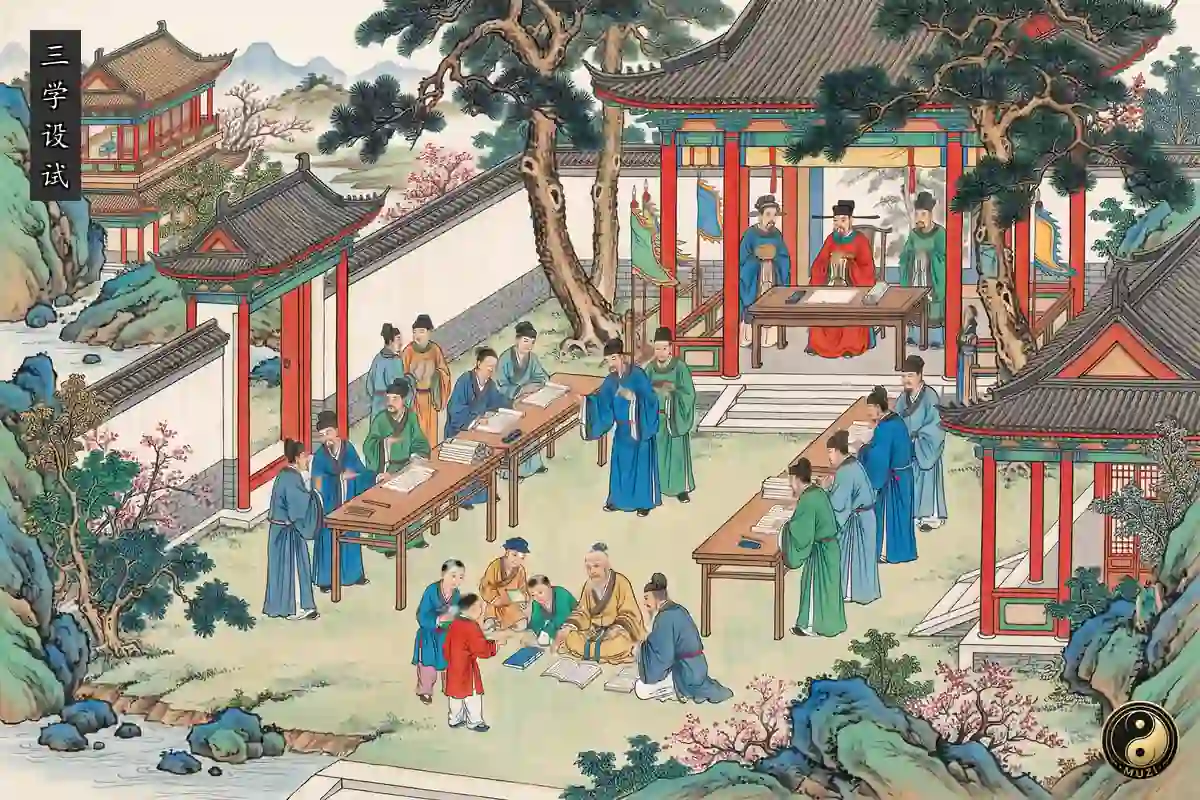
What the Three Halls System settled was how students of the Imperial University were to be promoted and demoted. The "Treatise on Selection" in the History of Song records that in the Qingli years the Imperial University once set up two hundred Inner Hall students, that in the early Xining years it added a hundred and fixed the overall quota at nine hundred; in the fourth year of Xining it built four lecture halls from the west galleries of the Xiqing and Chaoji courts and added lecturers to a total of ten, "two to lecture on each classic," and the students were "divided into three grades: those first entering the school were Outer Hall students," with promotion from the Outer to the Inner Hall and from the Inner to the Upper Hall, each studying one classic, and "tested monthly on his work, with the best sent up to the Secretariat." In the second year of Yuanfeng the Study Ordinance was issued, fixing "two thousand Outer Hall students, three hundred Inner Hall students, and one hundred Upper Hall students." In the early Shaosheng years the censor Guo Zhizhang memorialized of "the late emperor's establishing the Three Halls method" and asked to "restore the Yuanfeng law."
The tests had a fixed form: "in the private examinations, the first month of each season is classical meaning, the second month an essay, the third month a policy answer." Promotion depended on two things. A student had to place in the top two grades in the public examination to rise to the Inner Hall, and rate excellent or fair in the Inner Hall test to rise to the Upper Hall, and "all were promoted only after weighing their recorded conduct and skill"; the History of Song explains: "conduct means being teachable and not breaking the rules, skill means working on the classics and set essays." Inner Hall students excellent in both conduct and skill were ranked Upper Hall first class and "recommended to the throne for an official post," the middle class "awaited the palace examination," and the lowest "awaited the provincial examination." Here the rankings of the school were tied directly to the two stages of the examinations.
The extension came in several steps. In the second year of Yuanfu it was first ordered that "the prefectures practice the Three Halls method, with selection and promotion all as at the Imperial University"; in the first year of Chongning the chief ministers asked that "schools be set up in every prefecture and county," and an outer school, the Biyong, was built south of the city, where, as Cai Jing memorialized, "the Imperial University would house only the Upper and Inner Hall students, and the outer school would house the Outer Hall students," with a plan to raise the Upper Hall to three hundred, the Inner Hall to six hundred and the Outer Hall to three thousand; "prefectural students were sent up to the Imperial University every three years." In the Chongning years the court even "decreed that all selection be by promotion from the schools, and the prefectural dispatch examinations and the Ministry of Rites examinations be abolished." In the third year of Xuanhe it "abolished the Three Halls method in the prefectural and county schools, and only the Imperial University used it for testing," and "the capital prefecture and the circuits all selected by the examinations," while the inner and outer schools "all followed the established rules of Yuanfeng."
There are judgments on both sides. The abstract of the paper by Zu Hui and Fei Xikuan of Zhejiang University says that under Huizong the Three Halls Tribute method was created on the basis of Wang Anshi's Three Halls method, "combining school education with selection by examination and forming a whole system of training, selecting and employing talent, an attempt that had a far-reaching effect on the Ming and Qing examinations." The History of Song's own comment falls on two other subjects, the Classics-and-Conduct subject created in the Yuanyou years and the later Eight Conducts subject. Once the Eight Conducts subject was set up, "the three halls admitted people without examination, and often they staged outward appearances to fit the categories"; of the two subjects its verdict is that "for some decades the two subjects stood side by side, and yet not a single man stood out and made a name." The History of Song also describes how "since Chongning, scholars each followed their party; those who studied classical meaning reviled the errors of Yuanyou, those who valued poetry mocked the faults of the New Classics, and they attacked one another in a babble of voices." There were also factions inside the Imperial University: Yang Shi said Wang Anshi "made false teachings that daubed the eyes and ears of learners," Chen Guoting answered him, "this is a great fault of one-sidedness," and the students who were used to Wang's teaching "rose together and abused" Yang Shi.
The Southern Song still used the method. In the thirteenth year of Shaoxing "the Imperial University was first built," supporting seven hundred, "thirty Upper Hall students, a hundred Inner Hall students and five hundred and seventy Outer Hall students," and those who rose to the Upper Hall "all went directly to the palace answer." In the third year of Shaoxi, Zhao Ruyu and others criticized the situation then, "glory and disgrace, rise and fall, no longer come from the schools; virtue, conduct, the Way and the arts are decided by sealed papers," and asked to "follow the Halls method to foster talent, and select through the great triennial examination."
It is tied to several canons. Imperial Examinations: the History of Song's general preface says "since Renzong ordered counties and prefectures to build schools, the system has grown more complete since Xining, with schools set up all over the realm," and the Three Halls System is one way that schools and examinations were joined. Tang Six Schools: in the Tang "there are six schools, all subordinate to the Directorate of the Imperial Academy," and in the Song "all schools are subordinate to the Directorate of the Imperial Academy," so that the Imperial University stayed within that frame. Confucian Classics: Shenzong asked Wang Anshi, "today those who discuss the classics each differ, so how can virtue and the Way be made one?", and so "Wang Anshi's Documents, Odes and Meaning of the Rites of Zhou were issued to the schools, and are called the Three New Meanings of the Classics." Academy Regulations: Zhu Xi's Regulations ask learners to be "faithful in word and earnest in deed," while the "conduct" examined under the Three Halls is "being teachable and not breaking the rules"; read side by side, the study rules and the university's examinations each had their own measure.
The three-grade promotion in the Imperial University was laid out in the fourth year of Xining, and in the second year of Yuanfeng the quotas were fixed at two thousand Outer, three hundred Inner and one hundred Upper Hall students; in the Chongning years it was extended to the prefectures and for a time replaced the dispatch examinations and the Ministry of Rites examinations, and in the third year of Xuanhe it fell back to the Imperial University. The grades of the Upper Hall led straight to the palace and provincial examinations, and here school and examination were joined. Zu Hui and Fei Xikuan say the attempt had a far-reaching effect on the Ming and Qing examinations; the History of Song records that after the Eight Conducts subject was set up the three halls "admitted people without examination." The method went forward and back several times, and in the Shaoxi years of the Southern Song Zhao Ruyu was still asking to "follow the Halls method to foster talent."
Three Halls System is the class in the chapter on Education on promotion in the Song schools. It covers the Three Halls system introduced at the Imperial University during Wang Anshi's reforms in the Northern Song, in which students were examined in turn and moved up or down among the outer, inner and upper halls; it was extended to prefectural and county schools in the Chongning era, abolished there in 1121, and thereafter used only at the Imperial University.
 Literature
 History of Song
 People
 Wang Anshi
 Yang Shi
 Zhu Xi