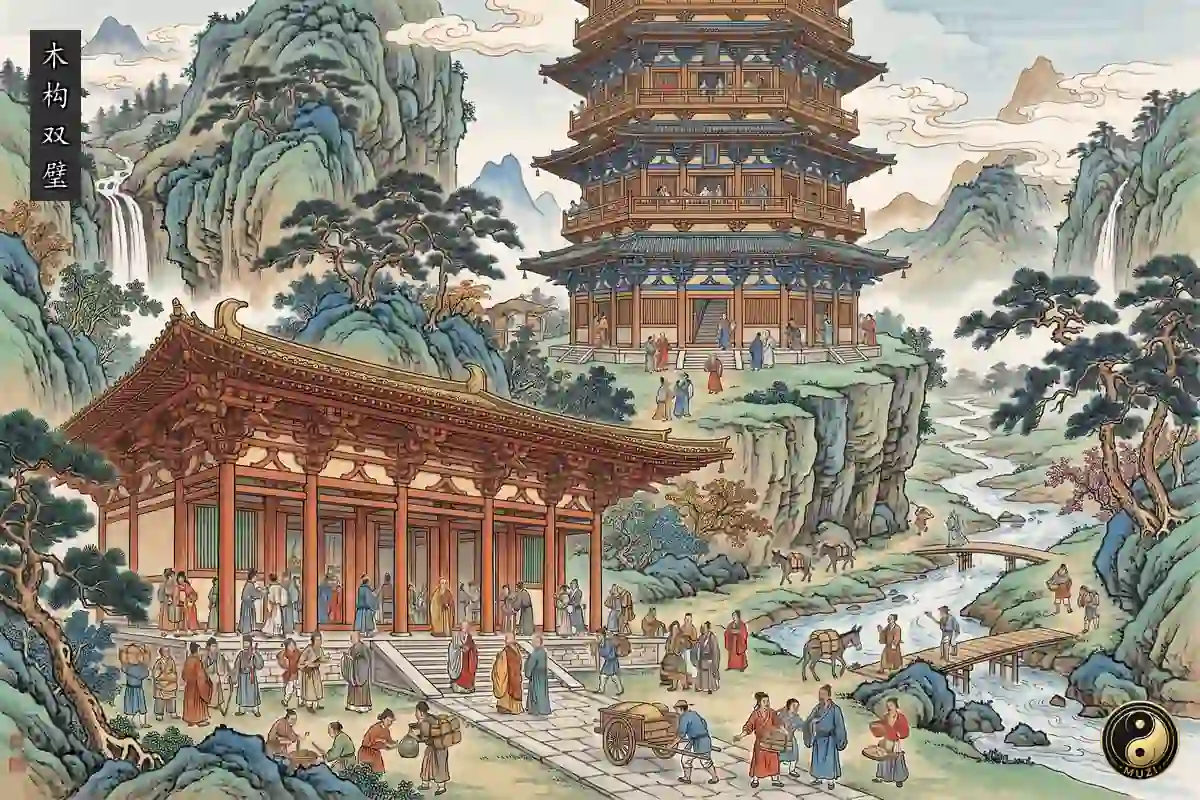
In the eleventh year of Tang Dazhong (857 CE), on the western slope of Foguang Mountain at the southern foot of Mount Wutai, a female patron named Ning Gongyu financed and the monk Yuancheng supervised the reconstruction of the East Hall on the former site of Foguang Temple, which had been burned during the Huichang Buddhist persecution. In the fifth year of Huichang (845 CE), Emperor Wuzong of Tang ordered the suppression of Buddhism, and Foguang Temple was burned to ashes, with only the Northern Wei Patriarch Pagoda surviving. The reconstruction twelve years later brought Foguang Temple back from the ashes. This single story hall, seven bays wide and four bays deep, measuring approximately 34 meters by 17.7 meters, supports an immense hip roof on inner and outer column grids, with bracket sets (*dougong*) reaching an astonishing height ratio relative to the columns.
In late June 1937, Liang Sicheng, Lin Huiyin, Mo Zongjiang, and Ji Yutang departed from Wutai county town, riding mules along a cliffside trail toward Doucun. The lead for this expedition came from photographs taken by the French sinologist Paul Pelliot at the Mogao Caves in Dunhuang: Cave 61's west wall features a mural of Mount Wutai approximately 13.4 meters wide, clearly labeling a site called *Da Foguang zhi Si* (Great Foguang Temple). This mural was painted during the Five Dynasties period but depicts the late Tang landscape of Mount Wutai. Liang Sicheng reasoned that if Foguang Temple was destroyed in Huichang 5 and rebuilt in Dazhong 11, and if no subsequent rebuilding had occurred, the current structure might be the original Tang dynasty building.
On July 5th, amid the dim beams of the East Hall, the team discovered faint ink inscriptions on the underside of a large beam. Among the deciphered text were the words *fo dian zhu: nu di zi Ning Gongyu* (hall patron: female disciple Ning Gongyu). Lin Huiyin subsequently found the same name, Ning Gongyu, on a stone dharani pillar in the courtyard, along with the explicit date *Dazhong shi yi nian* (the eleventh year of Dazhong), or 857 CE. The beam inscription and pillar inscription corroborated each other, establishing the East Hall's Tang dynasty construction date. The Buddha altar inside the hall also preserves life portrait polychrome sculptures of Ning Gongyu and the monk Yuancheng, among the earliest realistic portrait sculptures surviving in Chinese Buddhist art.
In the second year of Liao Qingning (1056 CE), in Yingxian approximately 85 kilometers north of Foguang Temple, Emperor Daozong Yelu Hongji of the Liao dynasty constructed the Sakyamuni Pagoda within the Fogong Temple in his grandmother's family homeland. Hongji had been raised in Yingxian at his maternal grandfather's home since childhood, following the Khitan custom of fostering Yelushi sons with the mother's clan, and he held deep emotional attachment to this land; the Sakyamuni Pagoda's construction may have been an act of filial remembrance for his late father Emperor Xingzong. This octagonal wooden pagoda stands 67.31 meters tall on a four meter stone platform, appearing as five stories externally but containing a hidden mezzanine between each level, giving it nine internal levels. The entire structure uses no iron nails and relies entirely on mortise and tenon joinery, with over one thousand types of bracket set combinations.
The East Hall of Foguang Temple and the Yingxian Sakyamuni Pagoda, one Tang and one Liao, one hall and one pagoda, are together hailed as the twin masterpieces of Chinese timber frame system. The East Hall displays the grandeur and majesty of Tang system through its expansive hall framing, while the Sakyamuni Pagoda demonstrates Liao dynasty craftsmen's highest mastery of tall timber construction through its precision joinery. Both buildings share a common characteristic: no iron nails, no mortar bonding, relying entirely on the interlocking bite of mortise and tenon joints between timber members for overall structural stability. In 2009, Foguang Temple was inscribed as part of Mount Wutai on the UNESCO World Heritage list. In 2013, the Sakyamuni Pagoda was included on China's World Heritage Tentative List.
The internal logic of these twin masterpieces' ability to stand for a millennium lies in the flexible redundancy provided by the mortise and tenon system. Rigid structures fail in earthquakes through brittle fracture, but mortise and tenon joints allow small relative rotations and slippage between members, converting seismic energy into frictional heat at the joints and gradually dissipating it, enabling the overall structure to remain standing through violent shaking. This is precisely the mechanical wisdom by which timber frame system conquers rigidity with flexibility and stands for a thousand years.