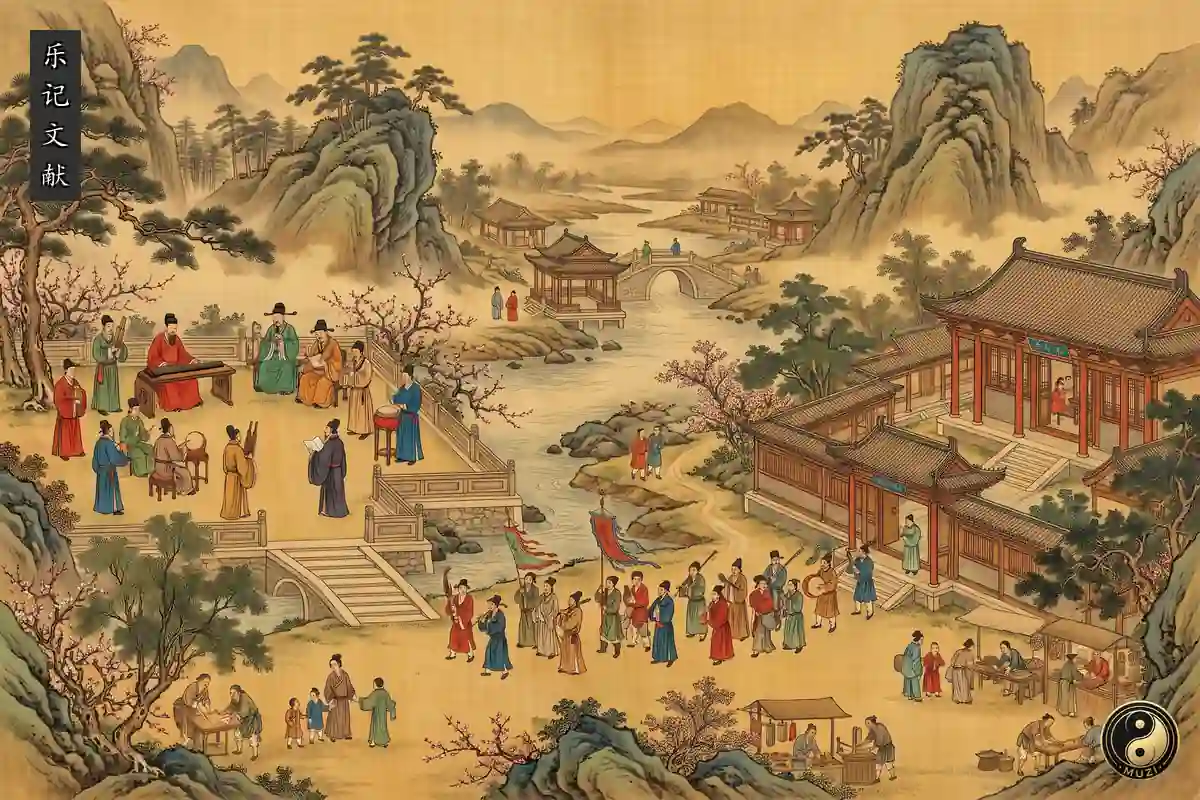
Across a misty spring landscape, scholars sit at outdoor tables before a hall and beside a bridge, reading, writing and discussing scrolls, while others walk the mountain paths under a low sun on the lake.
A gathering of Confucian writing on music, setting out moral teaching through rites and music and tying music to government and to the cultivation of the mind.
653 · ImpactThe Liji zhengyi, edited under Kong Yingda of the Tang, was promulgated with its commentary on the Yueji; the Old Book of Tang says the annual mingjing examinations were to follow it.
The Record of Music is today one chapter of the Book of Rites. Kong Yingda's commentary quotes Zheng Xuan's Table of Contents: "It is named Record of Music because it records the meaning of music." The commentary adds that the present text is eleven sections taken from the twenty-three listed in the Separate Records, and that the other twelve are still known "by name"; the eleven have titles of their own, such as Basis of Music, Discourse on Music, Bestowal of Music and Words on Music.
Who made it, the ancients did not agree. The Treatise on Literature in the Book of Han says: "In the time of Emperor Wu, Liu De, Prince Xian of Hejian, who loved the Confucian learning, together with Mao Sheng and others, gathered what the Rites of Zhou and the various masters said about music and made the Record of Music." The treatise also notes that his chamberlain's deputy Wang Ding passed it to Wang Yu, Prince of Changshan, who presented twenty-four rolls in the reign of Emperor Cheng, and that "when Liu Xiang collated the books he found twenty-three sections of the Record of Music, different from Yu's, and its way grew ever fainter". The Book of Sui preserves Shen Yue's reply, which repeats this account and also says "the Record of Music was taken from Gongsun Nizi". How it came into the Book of Rites is likewise told two ways. The Treatise on Classics in the Book of Sui says Dai Sheng cut down the Greater Dai's text to forty-six sections and called it the Lesser Dai Records, after which Ma Rong "also fixed the Monthly Ordinances, the Hall of Light and the Record of Music, making forty-nine sections in all"; Kong Yingda, following the Separate Records, says that the eleven sections of the Record of Music were already in the Book of Rites, "before Liu Xiang".
The Record of Music argues from the human heart: "All sounds arise from the human heart." From there it moves to government: "The music of a well-ordered age is calm and joyful, and its government is harmonious; the music of a disordered age is resentful and angry, and its government is perverse; the music of a ruined state is sorrowful and anxious, and its people are in distress." So one must "examine sound to know tone, examine tone to know music, examine music to know government, and then the way of rule is complete". It also sets music beside ritual: "Music makes for sameness, ritual makes for difference"; "Music is the harmony of heaven and earth; ritual is the order of heaven and earth"; for the self one must "use music to order the heart". Music can "make the people's hearts good", because "it moves people deeply and changes customs and habits".
These ideas have echoes in the histories. The Treatise on Rites and Music in the Book of Han records that Prince Xian of Hejian held that "the way of order cannot be completed without rites and music" and presented the court music he had gathered; the Son of Heaven "sent it down to the Grand Music Office, which kept it in practice" but "did not always use it". A passage of that treatise on rites and music, "Ritual restrains the people's hearts, music harmonizes the people's voices, government carries them out, punishment guards against wrongdoing", is worded as in the Record of Music. The Records of the Grand Historian, in its Treatise on Music, also has "Music is the harmony of heaven and earth; ritual is the order of heaven and earth". In the first year of the Tianjian era (502), Emperor Wu of Liang issued an edict saying "the way of sound is connected with government, and so it changes customs and habits", the first half of which matches the Record of Music's "the way of sound is connected with government" word for word. In the Tang, the Old Book of Tang records that in the third month of the fourth year of Yonghui (653) the Correct Meanings of the Five Classics by Kong Yingda was "issued to the whole realm, and each year the examinations in the classics follow it"; volumes thirty-seven to thirty-nine of the Correct Meaning of the Book of Rites are the Record of Music.
The disputes it raised are also in the sources. The Record of Music itself has Marquis Wen of Wei complaining to Zixia: "When I sit in formal cap and robe and listen to ancient music, I fear only that I shall fall asleep; when I listen to the sounds of Zheng and Wei, I do not tire." The Treatise on Rites and Music in the Book of Han records Emperor Ai citing Confucius, "banish the sounds of Zheng, for they are licentious", and decreeing "abolish the office of the Music Bureau". Ji Kang wrote On Sound Having No Grief or Joy, in which the Qin guest brings up "the music of a ruined state is sorrowful and anxious" and the host answers that "sound by itself has to do with good and bad, not with grief or joy" and that "sound has a natural harmony and is not tied to human feeling".
The Record of Music is tied to five other canons. With Rituals: the Record of Music says "music comes from within, ritual is made from without" and "sameness brings affection, difference brings respect"; ritual sets ranks, music gathers hearts. With Ritual Music and Dance: it counts "bells, drums, pipes and chime-stones, feathers, flutes, shields and axes" as "the instruments of music" and "bowls, platters, regulations and patterns" as "the instruments of ritual", which gives names to what is used in ceremony. With Confucian Classics: Shen Yue says "when Qin destroyed learning, the Classic of Music was lost", and since the five classics hold no music, writing on music was kept through this chapter of the Book of Rites. With Chinese Instrumental Music: the chapter says "the zither of the ancestral temple had red strings and slow-sounding holes" and "Shun made the five-string zither to sing the Southern Wind", placing the sound of zither and se beside the ancients' government and teaching. With Songs and Folk Tunes: the chapter sets "the sounds of Zheng and Wei" against ancient music; the Treatise on Rites and Music in the Book of Han records that Emperor Ai first cited "banish the sounds of Zheng" and then abolished the Music Bureau, the very office that had "gathered poems and chanted them at night" and taken in the songs of Zhao, Dai, Qin and Chu.
The Record of Music runs from "All sounds arise from the human heart" to "examine music to know government", treating what is heard and what is played as a way into the state of government. Its words stayed in the histories and the edicts: the Treatise on Rites and Music in the Book of Han has sentences worded as it is, Emperor Wu of Liang's edict uses "the way of sound is connected with government" as it stands, and the Correct Meaning of the Five Classics, which the Tang examinations in the classics followed, contains its commentary; Ji Kang, for his part, wrote On Sound Having No Grief or Joy and said that sound "is not tied to human feeling". A writing on music that survives in only eleven sections was quoted again and again by the court and also taken up for argument by later writers, and so the relation between music and government became a question that kept being asked.
Record of Music is the class in the chapter on Performance on Confucian writing about music, at the centre of which is the Record of Music: Liu De, Prince Xian of Hejian, and Mao Sheng compiled it in the Western Han from pre-Qin writings on music, Dai Sheng later included it in the Book of Rites, and in the Tang it became standard reading for the examination classics through the Correct Meaning of the Book of Rites. It links music with government and with the human heart, and holds that people should be taught through ritual and music.
The lecturer and listeners on the left terrace form the core scene of expounding music theory.
Instrument Display
The drum, string instrument, and winds before the terrace are the material basis of the music-theory discussion.
Right Hall Archive
The right-side academy hall and its blue plaque create the institutional space of preserving and ordering music texts.
Lower-Left Tutorial
The small tutorial with adults and children at the lower-left desk shows music education sinking into daily life.
At a study desk, a scholar collates music-theory texts: checking fragmentary bamboo strips of the lost Classic of Music and annotating pitch-ratio charts, with a qin zither resting beside piles of manuscripts. The foundational classic treating music as a mechanism for governance and inner alignment.
The Record of Music and the writings on it are like a bunch of flowers gathered from many hillsides: what the pre-Qin schools said about music lay scattered, and Liu De, Prince Xian of Hejian, and Mao Sheng picked it spray after spray and tied it into a single Record of Music.
Dai Sheng's Book of Rites took the bunch into the Confucian canon, and after the Correct Meaning of the Book of Rites under Kong Yingda was promulgated in the Tang, the commentary on the Record of Music became the standard reading for the examination classics.
It is told that a young scholar asked his teacher: why did the ancients, when they spoke of ritual, also speak of music?
The teacher did not answer at once but took up the zither on the table and plucked two notes. The earlier note was steady and the later one light. He asked the student: what is different in your heart when you hear them?
The student thought and said: the earlier made me sit up straight and the later made me want to laugh. The teacher nodded and said: this is what the ancients were thinking of.
Explanation
In the Western Han, Liu De, Prince Xian of Hejian, and Mao Sheng compiled the Record of Music from pre-Qin writings on music, giving Confucian music theory its first full text; Dai Sheng included the Record of Music in his Book of Rites, making it a chapter of the Confucian canon; in the Tang the Correct Meaning of the Book of Rites, produced under Kong Yingda, was promulgated and its commentary on the Record of Music became the standard reading for the examination classics. (This is an illustrative story, not a historical account.)





 Yueji ChaptersThe Book of Rites' nineteenth chapter, eleven sections joined as one
 Yueji CommentaryThe Yueji with Zheng Xuan's notes and Kong Yingda's subcommentary
 Xunzi on MusicChapter 20 of the Xunzi, on music that unites and ritual that sets apart
 Sound Without EmotionJi Kang's dialogue arguing that sound itself holds no sorrow or joy
 Canon
 Literature
 Book of Rites
 On Music Having No Sorrow or Joy
 Book of Sui
 People
 Confucius (Kongzi)
 Marquis Wen of Wei
 Liu Xiang
 Ji Kang
 Shen Yue
 Dai Sheng