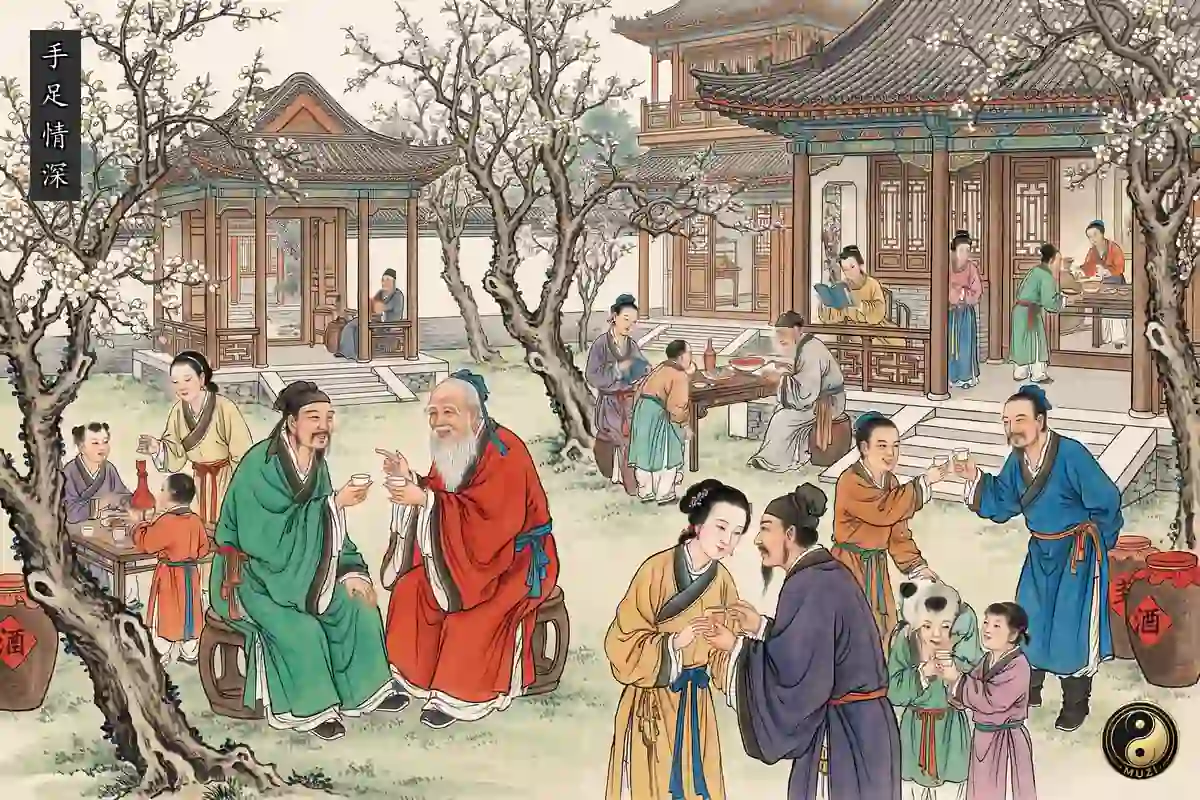
The Western Zhou ode Changdi in the Xiaoya of the Book of Songs sings: "Of all the people of today, none is like a brother." The brothers in the poem stand by one another in danger: "in the terror of death and mourning, brothers think deeply of each other"; "brothers quarrel within the walls, but outside they ward off affronts together", wrangling at home yet resisting outsiders as one. The poem does not hide the other side either: once the turmoil is over, "though one has brothers, they are not equal to friends". There are two accounts of where the poem came from. The Mao Preface says it is "a feast for brothers", written in grief that Guan Shu and Cai Shu had lost the right way; in the Zuo Commentary, under the twenty-fourth year of Duke Xi, the Zhou official Fu Chen says instead that "Duke Mu of Shao, grieved that the virtue of Zhou was not kept, gathered the clan at Chengzhou and made a poem", and adds that the Duke of Zhou "enfeoffed his kin as a fence and screen for Zhou". The two accounts differ, yet both tie the feeling between brothers to the Zhou practice of gathering the clan and granting fiefs to kin; by then the ethic of brotherly affection was already part of the teaching of the Songs.
Confucius's school placed this feeling in the order of how one becomes a person. Master You said: "Filial piety and respect for elder brothers: are they not the root of ren?" Confucius asked his disciples to be "filial at home, and respectful to elders when abroad" (Analects, Xue Er), and from then on filial piety and brotherly respect were named together.
After that, ritual and law set out degrees of nearness for the bond between brothers. The Mourning Garments chapter of the Etiquette and Ceremonial fixes mourning dress by closeness of kin: greater mourning for first cousins on the father's side, lesser mourning for second cousins, and sima hemp for third cousins; the more distant the tie, the lighter the mourning. In the fourth year of Yonghui under Emperor Gaozong of Tang (653), the Commentary on the Code in thirty juan, compiled by Zhangsun Wuji and others, was presented and issued throughout the realm (Old Book of Tang, Treatise on Punishments and Law). The Tang Code with Commentary lists "discord" among the Ten Abominations, meaning "plotting to kill or selling kin of the sima degree or nearer, or striking or accusing a husband, elders of the greater-mourning degree or nearer, or senior relatives of the lesser-mourning degree", and the commentary explains that these "are all offences among kin, in which the nine degrees of kin are not in harmony"; while for sons and grandsons to "register as separate households or divide the property" while grandparents or parents are alive falls under "unfilial conduct". In this way the grades of mourning were written into the definition of crimes. The summary at the head of the book cites "those who discuss it" as saying that "the Tang Code is wholly based on ritual", and records that when the Ming revised its code, "its sections were wholly based on the Tang".
In the Song, the circle of care was pushed out from brothers to the whole clan. In the Northern Song, Fan Zhongyan set up the Fan clan charitable estate at Suzhou, supporting clan members with the income of the clan land. The year of its founding is given in two ways: Wu Gou, who has written several books on Song history, gives the first year of Huangyou (1049), and Danjō Hiroshi gives 1050. Qian Gongfu's Record of the Charitable Fields says Fan Zhongyan "bought a thousand mu of reliably fertile land near the city wall, called the charitable fields, to feed and help the people of the whole clan", so that clan members "had food every day and clothing every year, and help for marriages and funerals", and that he "chose an elder of the clan who was worthy to manage its accounts"; his biography in the History of Song also records that he "set up a charitable estate in his home district to support his clansmen". Aoyama Sadao writes that charitable estates are said to have begun with Fan Zhongyan. Gong Hao and Wang Tao write that great families everywhere then "followed one after another, buying clan land, founding charitable estates and opening charitable schools"; by the figures they cite, there were about 65 clan-land charitable estates in the Song and Yuan, rising to 233 in the Ming and about 500 in the Qing, and in Suzhou alone the number grew from 3 in the Kangxi period to 165 in the Xuantong period. Wu Gou holds that the Fan estate ran for about nine hundred years, from its founding to the Republican era.
Family instructions and genealogies then carried this ethic into daily life at home. Yan Zhitui says in the chapter on brothers of his Family Instructions for the Yan Clan: "First there are people, then husband and wife; after husband and wife come father and son; after father and son come brothers. The closeness of one family is these three and nothing more." He also saw why brothers fall out: "Between brothers it is not as with others: where hopes are deep, resentment comes easily; where kinship is close, it is easily set aside." In the Northern Song, Su Xun, compiling his clan genealogy, wrote that "feeling shows in closeness of kin, and closeness shows in mourning dress"; mourning grows lighter "down to sima hemp, and then to no mourning at all", and with no mourning the kinship is spent, after which kin become "strangers on the road". He hoped that those who read the genealogy would find "the heart of filial and brotherly respect rising of itself". Zhang Zai of the Northern Song urged that to "hold together the hearts of all under heaven, gather the clan, strengthen customs and keep people from forgetting their roots", genealogies must be made clear and the system of the lineage heir set up. Brothers turned against each other also entered literature: A New Account of the Tales of the World, compiled by Liu Yiqing of the Southern Dynasties, records that Emperor Wen ordered the Prince of Dong'e to compose a poem within seven paces, and the poem said "we grew from the same root; why such haste to boil each other?", at which "the emperor looked deeply ashamed".
The ethic of brothers has also left its mark on several other canons. With Filial Piety: Master You named filial piety and brotherly respect together as "the root of ren", the Tang Code counted sons and grandsons who "register as separate households or divide the property" while parents were alive as unfilial, and Su Xun made his genealogy in the hope that a "heart of filial and brotherly respect" would arise. With Rituals: the Mourning Garments chapter of the Etiquette and Ceremonial marks the nearness of brothers and cousins by greater mourning, lesser mourning and sima hemp, and the Tang Code used these same grades to define "discord". With Lineage Trust Funds: Gong Hao and Wang Tao say that ownership of clan land "belonged to the clan collectively" and that it "could not be bought or sold privately", so that a charitable estate could support its members over the long term from a shared holding. With Marriage: Changdi sets "wife and children in harmony, like the playing of zithers" in the same poem as the happy concord of brothers, and Yan Zhitui likewise names husband and wife, father and son, and brothers together as "the closeness of one family".
The bond between brothers was first written into the lines of Changdi, then into the crimes of the Tang Code, and then settled on the clan fields of the Fan charitable estate, becoming step by step rules that could be carried out: mourning dress fixed degrees of kinship, the code punished "discord", the charitable estate gave clan members "food every day and clothing every year", and great families of the Ming and Qing followed its example one after another. Yan Zhitui warned brothers that "where hopes are deep, resentment comes easily", Su Xun feared that kin whose kinship was spent would become "strangers on the road", and the seven-pace poem gave voice to the pain of kin boiling kin; seeing that this bond could fade, people set down rites, laws and clan fields for it again and again.
Kinship is the class in the chapter on Values on the ethics among brothers and sisters and within the clan. Feeling between those of one flesh and blood, with respect between old and young, means fewer rifts among kin and more of the warmth of family.
 Literature
 Zuo Tradition
 A New Account of Tales of the World
 Tang Code with Commentary
 Record of the Charitable Estate
 People
 Fan Zhongyan
 Su Xun
 Zhang Zai
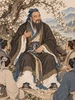 Confucius (Kongzi)
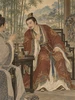 Liu Yiqing
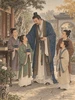 Yan Zhitui
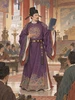 Zhangsun Wuji
 Duke Mu of Zhao (Ji Hu)