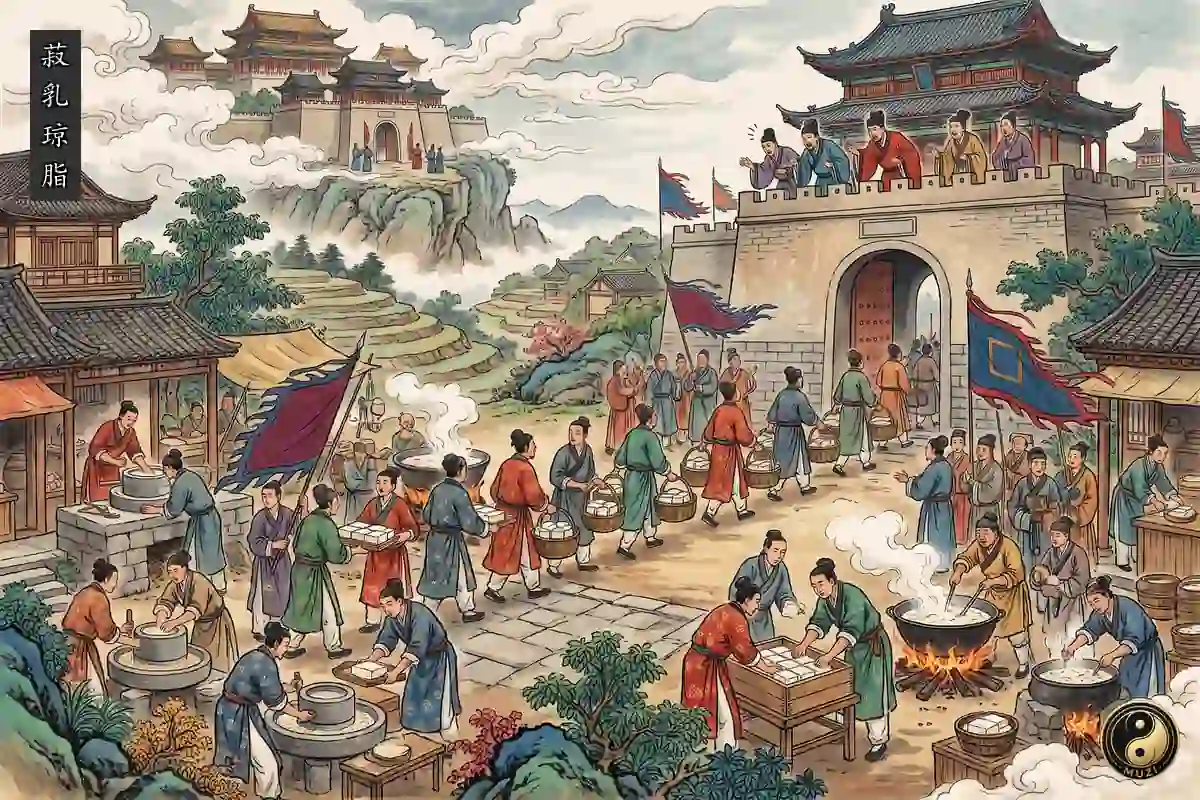
Soy milk steams in a great cauldron, a worker lifts curds in a cloth over a wooden frame, white tofu is pressed in wooden boxes and cut into blocks, and a basket of golden fried tofu and bowls of silken tofu with scallion stand beside them.
Soaking, grinding and setting beans with brine gave East Asian farming communities a low-cost plant protein; an early Song text already called tofu "little mutton".
1075 · EvolutionAccording to the Mianshui yantan lu, in the eighth year of Xining (1075) the Huaixi region suffered a great famine and the court “had tofu cooked to open the appetite of the hungry people” (cited by Lan Yong and Qin Chunyan).2014 · ImpactThe traditional tofu-making technique was listed in the fourth batch of the national intangible cultural heritage list (2014), with the Bagongshan Soy Products Co., Ltd. of Huainan as its protecting unit.
The weight of tofu is seen from two ends, the bean and the meat. The Book of Songs (Shijing), in “Xiaowan” among the Lesser Odes, sings: “In the middle of the plain there are beans; the common people gather them.” Shu is the bean the common people picked. Mencius (Mengzi), in “Jinxin shang,” says that a sage governing the world would “make beans and millet as plentiful as water and fire”; beans are named together with millet; for millet and the other grains, see Plant Foods. What turns a bean into something that can reach the table every day and stand in for meat is a handful of skills: soaking, grinding, boiling and curdling.
The Bencao gangmu (Compendium of Materia Medica), in the entry “tofu” in its grain section, gives the method: “Black beans, yellow beans, white beans, ni beans, peas and mung beans can all be used. The method: soak and grind, strain out the dregs, boil, and set it in the pot with brine, or mountain-sweetleaf, or sour whey, or vinegar dregs. There is also a way of setting it in a vat with gypsum powder,” and “the skin that sets on the surface is lifted off and dried; it is called tofu skin, and it is very good in dishes.” So the things used to curdle it are brine, mountain-sweetleaf, sour whey, vinegar dregs and gypsum, and the skin on the milk becomes tofu skin. The page “Traditional tofu-making technique” (listed in the fourth batch of the national list in 2014) on the China Intangible Cultural Heritage website records that around Bagong Mountain in Huainan, purple-sand stone mills are still used to grind the milk, earthen stoves and iron pots to boil it, and half-cooked gypsum to curdle it, and it says that the gypsum from the mountain was “an indispensable coagulant in early tofu production.”
Who first made tofu is not settled. The article by Lan Yong and Qin Chunyan of Southwest University appeared in Historical Geography (Lishi dili), issue 2 of 2017, and is reposted on the website of the Institute of History of the Chinese Academy of Social Sciences. It says that scholars hold four views on when tofu began: the Spring and Autumn and Warring States, the Han, the Tang and the Five Dynasties. Li Shizhen recorded that “the method of tofu began with Liu An, Prince of Huainan of the Han,” and the same China Intangible Cultural Heritage page says Bagong Mountain is “said to be” one of the birthplaces of tofu. The authors of the article instead take the stone carving in the Eastern Han tomb at Dahuting, Mixian, Henan, as showing that tofu was already made in Henan in the Eastern Han, and say that “in the Han, tofu production had formed a 'triangle of origin' in Anhui, Henan and Shandong”; this is their own judgement, and other views remain. As for written records, the Qingyi lu (Records of the Unusual and the Strange; formerly attributed to Tao Gu), in its section on officials, says: “Shi Ji served as assistant magistrate of Qingyang... meat was hard to come by, and he bought a few pieces of tofu a day. The townspeople called tofu 'little slaughtered sheep.'” On this basis Lan Yong and Qin Chunyan say that in the Five Dynasties tofu was already sold in the markets around Qingyang in southern Anhui.
Tofu's entry into the life of the streets is recorded more in the Song. The same article cites the Mianshui yantan lu: in the eighth year of Xining (1075), when the Huaixi region suffered a great famine, the court “had tofu cooked to open the appetite of the hungry people”; it cites Lu You's Laoxue'an biji, in which a man in Jiaxing ran a “tofu broth shop”; and it cites the Lin'an zhi, which has the place names Tofu Lane and Tofu Bridge in Lin'an, adding that in Song texts “it is said that tofu was the art of the Prince of Huainan” had become a shared understanding. Lu You's poem note says “the people of Shu call tofu by this name,” and the people of Sichuan called tofu “liqi.” Tofu gained shops in the streets, place names and other names, and so joined the city life described in Marketplace Hubs. The article also says that the Ming writer Li Rihua, in Penglong yehua, records the method of “the people of She county being skilled at making tofu”; that Song officials posted to Henan were routinely given “one jin of pork, two blocks of tofu and a bunch of greens a day” (the article uses the same line again for a Ming governor of Yunnan); that people in Zhejiang took tofu as an everyday substitute for meat; and that Sun Daya of Jiangyin, finding the word for tofu inelegant, changed it to “shuru” (bean milk), which is the title of this section. It also lists the many names tofu has had: doufu, ruzhi, liqi, xiaozaiyang, shuru, douru, shuiban and others.
The books of medicine took it in too. The Compendium of Materia Medica says tofu “eases the middle and boosts qi, harmonises the spleen and stomach, relieves bloating and fullness, and brings down turbid qi in the large intestine” (citing Ning Yuan), and “clears heat and disperses blood” (Li Shizhen); its attached recipes include “for chronic dysentery: boil white tofu in vinegar and eat it, and it will heal,” and the same book also says that someone who loved tofu was poisoned and was cured with radish soup. Once in a prescription, tofu entered the food therapy of Traditional Medicine. When tofu is fermented further into fermented tofu and fermented black beans, it falls within the range of Fermentation Condiments.
The name “little slaughtered sheep” makes tofu's weight plain: it was often taken in place of meat. In the Book of Songs the common people pick beans, and Mencius would make beans and millet as plentiful as water and fire; in a Song famine in Huaixi the court had tofu cooked to open the appetite of the hungry, a man in Jiaxing ran a tofu broth shop, and Lin'an had a Tofu Lane and a Tofu Bridge; the Compendium of Materia Medica records the method of soaking, grinding, boiling and curdling, and also writes tofu into its attached recipes. Who first made tofu is still argued among four views; how it entered the streets, the medical books and the everyday table can be traced step by step in the records.
Tofu and Soy Foods is the class on beans and bean products in the chapter on the Cuisine. It starts from the soybean and takes in tofu, soy milk and yuba, together with vegetarian cooking and bean snacks. Tofu, made by setting soy milk with a coagulant such as brine or gypsum, is the centre of the class; fermented bean products belong to the classes on fermented curd and douchi, and on sauces and pastes.
Workers at the lower-left stone mill grind beans into slurry, the first stage of tofu making.
Coagulating Tofu
Figures at the lower-right mold work the curd, showing the key step where soy milk sets into tofu.
Boiling Soy Milk
The steaming cauldron at right shows soy milk being heated and boiled.
Workshop Grinding
The upper-left workshop also shows bean grinding, reinforcing the continuous production process.
A tofu workshop hums: a stone mill grinds soaked soybeans, brine curdles the milk in a cauldron, a press squeezes out the whey, and slabs of silken tofu are carried to market. An inorganic chemical coagulation technique delivering an accessible plant protein revolution.
Tofu and soy foods are like the several places a handful of beans can go: soaked soft and ground into milk, the milk brought to the boil, a little brine dropped in, and it gathers into a block; the thin film that forms on the surface of the milk, lifted off and dried, is yuba.
the Qingyi lu of the early Song (attributed to Tao Gu) records tofu being called "little mutton" by local people; Li Shizhen's Compendium of Materia Medica describes the method in detail and records the tradition that it began with Liu An, Prince of Huainan.
Early in the morning a family made tofu in the kitchen. The beans had been soaked soft the night before, and now they went into the stone mill spoonful by spoonful and came out as white soy milk.
The mother strained the milk and poured it into a pot to boil. The daughter stood watching and asked: how do we get it to turn into blocks? The mother took a small bowl of brine and dripped it slowly in along the edge of the pot, saying: a little at a time, it cannot be hurried.
The milk in the pot slowly drew together into soft white curds. The mother said that scooped out as it was, it was tofu pudding, and some of it would be made into soft tofu and firm tofu. The daughter tasted a mouthful and said: it is good hot.
Tofu is a bean food made by setting soy milk with a coagulant, the coagulants in common use being brine, gypsum and glucono-delta-lactone; set tofu pudding is counted under tofu. On the origin of tofu there are different views, such as a Han origin and a Tang or Song origin, and the question is unsettled; the Qingyi lu of the early Song (attributed to Tao Gu) records tofu being called "little mutton" by local people. (This is an illustrative story, not a historical account.)



 Beans and PulsesSoybeans and the other pulses: mung, adzuki and broad beans.
 TofuTofu set from soy milk, in soft, firm, dried, fried and frozen forms.
 Soy Milk and YubaSoy milk, and yuba and bean-curd sticks made from it.
 Vegetarian CuisineMeatless cooking, from monastery vegetarian meals to dishes made to imitate meat and fish.
 Bean SnacksSnacks made from soy products, such as stinky tofu.
 Canon
 Literature
 Classic of Poetry
 Mencius
 Compendium of Materia Medica
 People
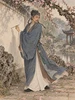 Lu You
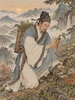 Li Shizhen
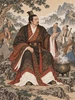 Liu An
 Tao Gu
 Atlas
 Mount Bagong in Huainan
 Flavor