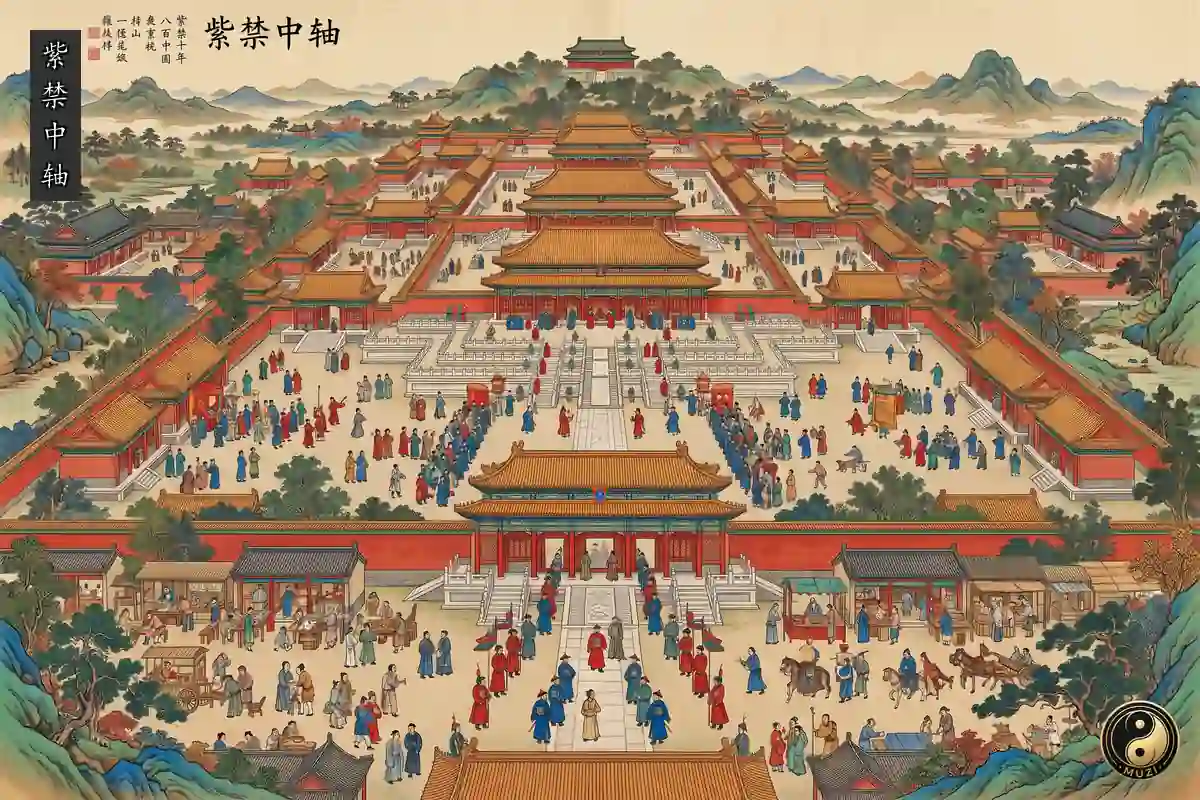

Imperial Architecture covers the building of the court and the government: palace cities and capitals laid out along a north-south axis, with the Ming and Qing Forbidden City as the lead example; and the altars and temples of the state cult, such as the Hall of Prayer for Good Harvests at the Temple of Heaven, along with the Xiannong and Sheji altars, the Ancestral Temple, Confucian temples, the temples of the Five Sacred Mountains, government offices, the examination hall and the state school, and the walls and gates of administrative cities. Frontier passes belong to Infrastructure, civil streets and lineage and guild halls to Streets & Settlements, Buddhist, Daoist and folk-cult temples to Temples, and timber joinery and brackets to Timber Building.
The Rites of Zhou (Zhouli), “Kaogong ji”, gives the craftsmen's method of laying out a capital: “The craftsman lays out the state capital: nine li square, three gates on each side; within the capital nine north-south and nine east-west avenues, each avenue nine carriage-tracks wide; the ancestral temple on the left and the altar of the soil on the right.” The Beijing Central Axis, inscribed on the World Heritage List in 2024, embodies in its location, layout and design the ideal-capital model prescribed in the Kaogong ji; the Axis originated in Dadu, the capital built in the Yuan (1271-1368), which corresponds to its northern section, later structures were built under the Ming, and the Qing improved it. So the Forbidden City is not where the axis begins, but a group of palaces that the Ming set upon it.
The accounts of how the palace city was completed are close but different. The History of the Ming (Mingshi), “Treatise on Geography”, says: “In the first year of Yongle, first month, it was raised to be Beijing”; “in the fourth year of Yongle, intercalary seventh month, an edict ordered the building of the Beijing palaces and the repair of the city walls”; “in the nineteenth year, first month, it was completed”. The Mingshi “Annals of Emperor Chengzu” records for the eighteenth year of Yongle: “eleventh month, wuchen: an edict announced the move of the capital to Beijing to the realm”, and in the twelfth month “guihai: the suburban altars, ancestral temple and palaces of Beijing were completed”. Another account writes that in the eleventh month of Yongle 18 (1420) Zhu Di issued an edict announcing the completion of the Beijing palaces, and that on the first day of the first month of the following year he received congratulations in the Fengtian Hall (now the Hall of Supreme Harmony); a further account gives construction between 1406 and 1420. What each account calls “completed” is sometimes an edict, sometimes the altars, temple and palaces, and sometimes the report of completion; this entry does not merge them. The months cited here from the Mingshi and from the edict are lunar months, and this entry does not convert them.
The order inside the palace city is this: the center of the outer court is the Halls of Supreme, Central and Preserved Harmony, together called the three great halls, where the state held its great ceremonies; the center of the inner court is the Palaces of Heavenly Purity, Union and Earthly Tranquility, together called the rear three palaces, the main residence of the emperor and empress. The Mingshi writes that the palace city is “six li and sixteen bu around, also called the Purple Forbidden City”, with on the south “the first gate Chengtian, the second the Meridian Approach, the third Wumen”, one after another. The outer court lies in front and the inner court behind, laid out one after the other along the same line.
Behind the axis was a large mobilization. The Mingshi “Annals of Emperor Chengzu” records the edict of the fourth year of Yongle: “in the intercalary month, renwu, an edict ordered the Beijing palaces to be built in the fifth month of the following year, and ministers were sent to cut timber in Sichuan, Huguang, Jiangxi, Zhejiang and Shanxi”. The Mingshi “Treatise on Food and Money” says: “The levy of timber began with Chengzu's building of the Beijing palaces; in the fourth year of Yongle the minister Song Li was sent to Sichuan”, and says that among the levies, “the largest and hardest was the levy of timber”. Supplying the capital depended on grain transport: the “Treatise on Rivers and Canals” writes: “Emperor Chengzu began building Beijing and carried grain from the south-east”, with a transport route “from the river mouth in the south to the Datong bridge in the north, over three thousand li”; and the “Biography of Song Li” records: “in the ninth year he was ordered to open the Huitong river”, the man ordered being the same Song Li sent to Sichuan for timber in the fourth year of Yongle. Timber-cutting and river-opening meet in one man.
Not long after the palaces were completed there was a fire. The Mingshi “Annals of Emperor Chengzu” records for Yongle 19 (1421): “summer, fourth month, gengzi: the Fengtian, Huagai and Jinshen halls were destroyed by fire, and an edict ordered the ministers to speak plainly of the court's faults”, and also the edict issued then: “an edict halted measures inconvenient to the people and works not urgent, remitted arrears of taxes up to the seventeenth year, and spared last year's flood-stricken field levies”. When the main halls on the axis burned, the court's first response was an edict seeking criticism and one stopping works and easing taxes, which suggests that these halls were also read at the time as a place to read the court's successes and failures. This is a reading from two Mingshi entries; the Annals do not say that the edicts were issued because of the fire.
As for the emperors who issued commands in the palace, one account gives fourteen Ming and ten Qing emperors over 491 years in all; another says that fourteen Ming and ten Qing emperors were enthroned over the following 505 years. Neither gives its start and end; this entry does not merge them. The planning principles of the Beijing Central Axis reflect Confucian ideas expressed in the Kaogong ji, using symmetry and balance to give society neutrality and harmony.
The Hall of Prayer for Good Harvests at the Temple of Heaven has changed its name and shape several times. The Mingshi “Treatise on Rites” records that in Hongwu 10 the joint-sacrifice rite was fixed: “following the old form of the round mound, but covering it with a roof, it was named the Dasi Hall, twelve bays in all”, and adds that “when Chengzu moved the capital to Beijing, he followed its form”. When the capital moved to Beijing under Yongle, this hall was the Dasi Hall and was rectangular; in the Jiajing years it was changed into the Daxiang Hall and made round. One account writes that in Jiajing 20 (1541) the Dasi Hall was pulled down, that in Jiajing 21 (1542) the Daxiang Hall was begun and in Jiajing 24 (1545) completed, a round hall with three-tiered eaves; that in Qianlong 16 (1751) the Qianlong emperor ordered the Daxiang Hall renamed the Hall of Prayer for Good Harvests; and that on the twenty-fourth day of the eighth month of Guangxu 15 (1889) the hall was struck by lightning and burned down, and in 1896, working from the craftsmen's memories, it was rebuilt essentially to its original pattern. The name Daxiang Hall was fixed by the Jiajing emperor, who also drew the plan himself; the Dasi Hall is dated to Yongle 18 (1420), and the Temple of Heaven was completed in 1420 together with the Forbidden City. So 1420 is the date of the Dasi Hall, 1545 the completion of the Daxiang Hall, and only in 1751 did the name of the Hall of Prayer for Good Harvests appear. The twenty-fourth day of the eighth month is a lunar date.
The sacrifice to which this hall belongs has texts to rest on in the ritual books. The Book of Rites (Liji), “Yueling”, for the first month of spring: “In this month the Son of Heaven prays for grain to the Lord on High on the first day.” The Liji, “Jiao te sheng”: “The suburban sacrifice greets the arrival of the long days and is the great thanks to Heaven, with the sun as the chief; its site is marked in the southern suburb, taking the place of yang; the ground is swept and the sacrifice made there, honoring its plainness.” The Rites of Zhou, “Chunguan”, in the passage of the Grand Director of Music: “At the winter solstice, music is played on the round mound on the ground; if the music changes six times, the spirits of heaven all descend and can be honored with rites”; and the office of the Grand Minister of Ritual includes “sacrificing to the August Heaven, Lord on High, with the yin offering”. A sacrifice to Heaven at the round mound at the winter solstice and a prayer for grain to the Lord on High in early spring can each be found in the ritual books. The site, planning and architectural design of the Temple of Heaven, together with its rites and music, rest on ancient principles that tie numbers and spatial order to belief in Heaven and to the relation between people and Heaven, with the emperor mediating as the “Son of Heaven”.
How the sacrifice to Heaven was to be made was, under the Ming, a matter that moved the court. The Mingshi “Treatise on Rites” sums up: “As for Shizong, he took on himself the making of rites and music. The greatest of his changes was the separate sacrifice to Heaven and Earth”; in Jiajing 9 the separate sacrifice was restored, in the seventeenth year the Dasi Hall was removed, and “in the twenty-fourth year the Daxiang Hall was built on the site of the old Dasi Hall”. The two accounts do not agree on the year the Dasi Hall was pulled down: the Treatise on Rites says Jiajing 17, another account says Jiajing 20 (1541), and the two are set side by side here without merging. One account writes that in Jiajing 17 Yan Song and others petitioned that the autumn sacrifice should be held in the Dasi Hall, that the Jiajing emperor did not agree, and that he ordered the officials who had spoken plainly in their memorial thrown into prison. The origin of the name Temple of Heaven is also told in several ways: one says the Altar of Heaven and Earth was renamed the Temple of Heaven in Jiajing 13 (1534); another says that in 1545 the separate sacrifices to Heaven and Earth came about, and the altars of Heaven, Earth, Moon and Sun were built in the south, north, west and east of Beijing, whereupon the name Temple of Heaven was formally given, while the same account also says the round mound was built in 1530, which does not fit the line that the separate sacrifices “only then came about”. The name Temple of Heaven stands in several versions.
The columns of the hall have been counted into a scheme of astronomy and the calendar: the 4 dragon-well columns in the hall stand for the 4 seasons of the year, the 12 inner columns for the 12 months, the 12 outer eave columns for the 12 double-hours of a day, the inner and outer columns together, 24 in all, for the 24 solar terms, and these 24 plus the 4 dragon-well columns, 28 in all, for the 28 lunar lodges; the 4 dragon-well columns also divide the interior into five places, east, west, south, north and center, matched with the five phases. This is one reading of today, not a record in the histories.
It meets other canons at several concrete points. Rituals is about carrying out the rites: the position and symmetry of the Beijing Central Axis are tied to the Confucian ideas set out in the Kaogong ji, and “ancestral temple on the left, altar of the soil on the right” is one line of the Kaogong ji; the sacrifice of the Hall of Prayer for Good Harvests rests on the words of the Jiao te sheng and the Rites of Zhou, and the Zhongyong also says: “The rites of the suburban and earth sacrifices are how one serves the Lord on High.” Lunisolar Calendar is about the calendar: the “first day” of the early-spring prayer for grain in the Yueling is a day in the calendar, and the 24 columns match the 24 solar terms. Yin-Yang & Five Elements is about yin and yang and the five phases: in the Warring States period the yin-yang school arose, taking Heaven as yang and Earth as yin, and so the round mound was set in the southern suburb and the square mound in the northern; the five places inside the hall match the five phases. Confucian Classics is about the classics, and the Yueling and Jiao te sheng both come from the Liji, in which the Zhongyong is also included. The Temple of Heaven is not on the central axis, but its main gate is on the central axis; when the emperor came out of the Palace to sacrifice to Heaven and pray for grain at the Temple of Heaven, he had to come by the central axis and then enter the main gate. Crypt Architecture is about tombs: the Mingshi “Annals of Emperor Chengzu” records for Yongle 7 “fifth month, jimao: a mountain tomb was laid out at Changping, and the mountain named Tianshou”, in the same reign as the order of Yongle 4 to build the palaces. Grand Canal is about grain transport, and the two Mingshi passages above are where the palace city and the canal meet.
With only the Kaogong ji, the axis of Beijing would be only a plan, not a palace city lived in for centuries on top of it; nor would we see how one edict drew on the timber of five provinces and the grain of one river, and after a fire brought an edict seeking criticism. The Kaogong ji gives the ideal and the Mingshi records the cost; read together they show how the axis came down to earth step by step.
The Forbidden City was first an edict, then the timber of five provinces and the grain of one river, and at the end a row of halls with the outer court in front and the inner court behind, along a north-south line the Yuan had already laid down. Soon after completion the three halls burned, and the emperor ordered his ministers to speak plainly of his faults. On the side of the rites, the Hall of Prayer for Good Harvests took three shapes on the same foundation, and even the year the earlier hall was pulled down differs between two accounts; the ritual books write of the early-spring prayer for grain and the winter-solstice sacrifice, while whether to sacrifice jointly or separately was settled in the disputes of the Jiajing reign. The rule is written in a book, the building takes labor, and when it burns the first question is what the government has done wrong: that is the weight of Imperial Architecture.
Imperial Architecture is the class in the chapter on Architecture on royal and governmental building. It covers palace cities and capitals laid out along a north-south axis, with the Ming and Qing Forbidden City as the lead example: in 1406 (Yongle 4 of the Ming) the court ordered the Beijing palaces built, they were completed in 1420 with the outer court in front and the inner court behind, and the Qing kept them until the end of the dynasty; the capital plan of the ancestral temple on the left and the altar of the soil and grain on the right is recorded in the Kaogong ji. It also covers the altars and temples of the state cult, such as the Hall of Prayer for Good Harvests at the Temple of Heaven, which began as the Dasi Hall completed in 1420, became the Daxiang Hall on the same site in 1545 and was renamed in 1751; beyond it come the Xiannong and Sheji altars, the Ancestral Temple, Confucian temples, the temples of the Five Sacred Mountains, government offices, the examination hall and the state school, and the walls and gates of administrative cities. Frontier passes belong to Infrastructure, civil streets and lineage and guild halls to Streets & Settlements, Buddhist, Daoist and folk-cult temples to Temples, and timber joinery and brackets to Timber Building.
 Literature
 Doctrine of the Mean
 History of Ming
 People
 Zhu Di
 Yan Song
 History
 Yongle Capital Relocation
 Atlas
 Xiannongtan
 Flavor