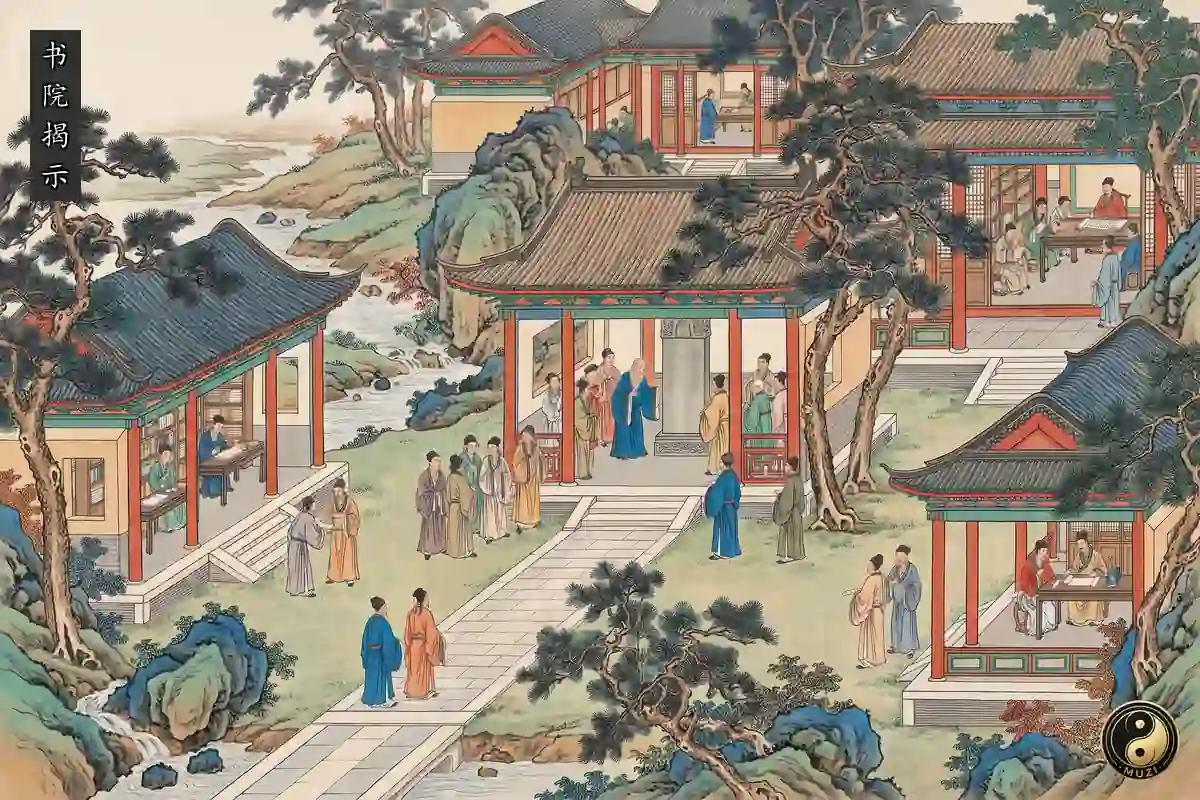
An academy is a place for reading and lecturing, and a regulation notice is a set of rules written out and hung over the lintel. The History of Song records in the biography of Zhu Xi that in the fifth year of Chunxi (1178), when Shi Hao became chief minister again, Zhu Xi "was appointed prefect of Nankang Army"; after reaching the prefecture he went from time to time to the prefectural school and "drew the students in to discuss with them," and also "sought out the ruins of the White Deer Grotto Academy, memorialized to restore it as of old, and made study rules for it to keep." The biography dates only the appointment; the years of the visit, the restoration and the writing of the Regulations are not stated on any of the pages used here, so they are not given.
The Regulations begin by listing "affection between father and son, duty between ruler and minister, distinction between husband and wife, order between old and young, and trust between friends," and Zhu Xi notes: "The above are the items of the Five Teachings. Yao and Shun made Xie the Minister of the Multitude to reverently spread the Five Teachings, which is just this. Learners learn this and nothing more." The Mencius has the line "made Xie the Minister of the Multitude to teach human relationships." Next comes the order of study: "study widely, inquire carefully, reflect with care, discriminate clearly, practice with earnestness," a line that comes from the Doctrine of the Mean. Then come the main points on cultivating oneself, handling affairs and dealing with others, among them "setting right what is just without scheming for profit, making clear the Way without counting the merit," which the Book of Han in the biography of Dong Zhongshu gives as "setting right what is proper without scheming for profit, making clear the Way without counting the merit." These sets of sentences can all be found in the Mencius, the Doctrine of the Mean and the Book of Han; this is a conclusion from comparing the texts, and the Regulations themselves say only that they are drawn from the sages' ways of teaching.
He explains why he did it this way: "not merely wanting them to strive for wide reading and fine writing, so as to angle for fame and take profit and rank." He also says that "of late there have been rules for study, but the way they treat learners is shallow," and so "I now do not apply them in this hall," taking only the main points of how the sages taught learning, to "list them as above and hang them over the lintel."
The situation at the time can be seen in the biography of Lu Jiuyuan. Lu Jiuyuan and Zhu Xi had at Goose Lake "argued and found their studies mostly did not agree"; when Zhu Xi governed Nankang, Lu came to visit, and "Zhu Xi took him to the White Deer Grotto, where Lu Jiuyuan lectured on the chapter on the gentleman and the petty man in regard to righteousness and profit, and some of his hearers wept," and Zhu Xi "judged that it hit the hidden and deep-rooted fault of the students"; as for "the debate over the Limitless and the Supreme Ultimate," the two "exchanged letters and argued without stopping." The same lecture hall could hold people of different schools.
There are two more records of how the rules spread. Yi Hwang's Memorial on the Ten Diagrams of Sage Learning takes the "Diagram of the White Deer Grotto Rules" as its fifth diagram, writing that the academy "gathered pupils, set up rules, and made the Way clear; the teaching of the academies then flourished across the realm," and also that "the rules' pursuit of principle and earnest practice are all rooted in the Five Relations." At the head of the Reading by Yearly Schedule of the Yuan scholar Cheng Duanli the White Deer Grotto Academy Rules are set beside the Rules of Cheng and Dong, with a note saying "the White Deer Grotto rules are what Master Zhu, Lord Wen, gathered from the sages' ready-made instruction."
Under the Qing, the academies came into the sight of the court. The Draft History of Qing, in its "Treatise on Selection," says: "Academies were set up in the provinces to supplement what the schools could not reach, first in the provincial capitals," and "the Confucian schools declined, the teaching officials did not do their duty, and what formed scholars lay in the academies alone." The imperial edict of the first year of Qianlong (recorded in the Danshui Gazetteer) recalls that "our Shizong, the Emperor Xian, ordered them set up in provincial capitals and gave funds for the students' lamp oil." It likens the academies to "the schools of the ancient feudal states," because "scholars from all quarters cannot gather" at the capital, and requires the academies to "follow in good measure the rules of Master Zhu's White Deer Grotto and set out their ceremonial, to restrain body and mind," adding that "to apply oneself only to the examinations is already the least part of a scholar's work."
The Regulations bear on several other canons. Confucian Classics: the sentences of the Regulations are taken from the Mencius and the Doctrine of the Mean. Imperial Examinations: Zhu Xi and the Qianlong edict both set fame, profit and the examinations against the purpose of study. Three Halls System: in the third year of Shaoxi, Zhao Ruyu and others criticized the situation then, "glory and disgrace, rise and fall, no longer come from the schools; virtue, conduct, the Way and the arts are decided by sealed papers," and asked to "follow the Halls method to foster talent." Western Learning: in the twenty-fourth year of Guangxu, the emperor required "the learning of the sages on righteousness and principle to be planted at the root, while taking widely from Western learning what suits the times, and applying it in earnest," and ordered that "the large and small academies of the provinces, prefectures, departments and counties be altogether changed into schools that teach both Chinese and Western learning"; but "before long came the coup of the eighth month," and only in the twenty-seventh year was there "talk of reviving the schools." That edict also provided that "the large academies of the provincial capitals be made higher schools, those of the prefectural cities middle schools, and those of the departments and counties primary schools," and that the academies' funds be "all turned over to the school funds."
A few lines posted over a lintel list the Five Teachings, the order of study, and the main points of cultivating oneself, handling affairs and dealing with others, in sentences that can mostly be found in the Mencius, the Doctrine of the Mean and the Book of Han. Zhu Xi said study was not for angling for fame and taking profit and rank; Lu Jiuyuan lectured at the White Deer Grotto on righteousness and profit, and some who listened wept. Rules drawn up for one academy were later set into the Reading by Yearly Schedule of the Yuan scholar Cheng Duanli, drawn into Yi Hwang's Memorial on the Ten Diagrams of Sage Learning, and written into the edict of the first year of Qianlong, which told the academies to "follow in good measure the rules of Master Zhu's White Deer Grotto" When the academies were ordered in the twenty-fourth year of Guangxu to become schools teaching both Chinese and Western learning, the edicts of that year still required "the learning of the sages on righteousness and principle to be planted at the root."
Academy Regulations is the class in the chapter on Education on the rules of the academies. It covers Zhu Xi of the Southern Song rebuilding the White Deer Grotto Academy and issuing its Articles of Learning, the Yongzheng-era Qing bringing academies under official funding, and the edict of 1901 converting the academies into modern schools.
 Literature
 Mencius
 Book of Han
 People
 Zhu Xi
 Lu Jiuyuan