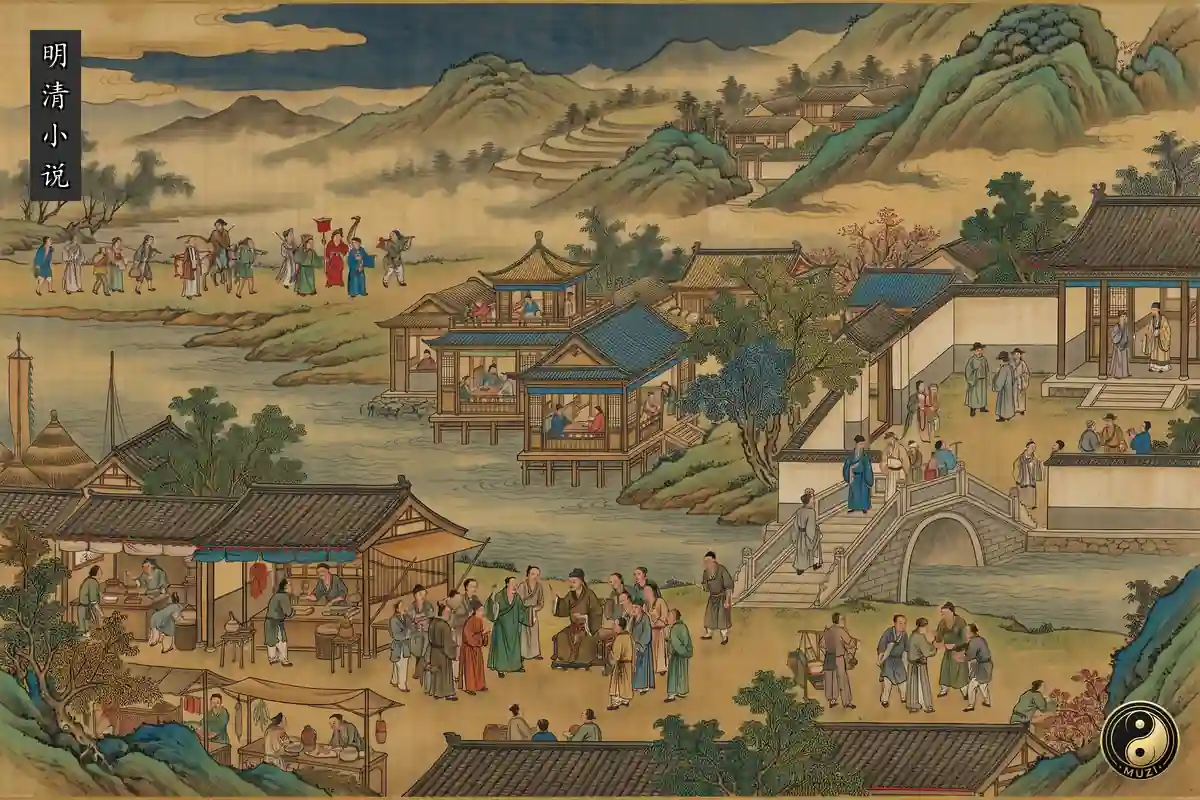
These novels are written in the vernacular, are long, and are told in chapters, each chapter telling one stretch of the story and the next taking it up. In A Brief History of Chinese Fiction, Lu Xun says of Luo Guanzhong's Romance of the Three Kingdoms (Sanguozhi yanyi, now generally called Sanguo yanyi): “of those that can be seen today the edition printed in the jiayin year of the Ming Hongzhi reign (1494) is the oldest, in twenty-four scrolls and two hundred and forty chapters.” Its roots lie in storytelling: Dreams of Splendor of the Eastern Capital records the entertainers of the capital's tile-markets, among them “Sun Kuan, Sun Shiwu, Zeng Wudang, Gao Shu, Li Xiaoxiang, historical tales,” and “Li Zao, Yang Zhongli, Zhang Shiyi, Xu Ming, Zhao Shiheng, Jia Jiu, short stories,” and also “Huo Siju, telling the Three Parts; Yin Changmai, the History of the Five Dynasties”; Notable Sights of the Capital lists four schools of “storytelling”, among them “historical books, which tell of the rise and fall and the wars recorded in the books and histories of former ages,” and says “the storytellers of short stories are the most feared, because with the tale of a single dynasty they can pick a matter apart in a moment.”
In the preface he wrote in the jiayin year of the Hongzhi reign (1494), Yongyuzi explains why the long narrative should use plain words: “In former times wild histories were made into storytellers' scripts and told by blind performers, but the words were coarse and lost themselves in vulgarity, and gentlemen disliked them”; Luo Guanzhong, taking the biography by Chen Shou and checking it against the state histories, composed the Popular Romance of the Three Kingdoms, of which the preface says: “its writing is not very deep and its words not very common; it records events as they were and comes close to history.” The preface prizes “Kongming's loyalty, bright as the sun and stars,” along with the righteousness of Guan Yu and Zhang Fei, and says that the rest of the gains and losses come down to the difference between “the worthy and the unworthy, the gentleman and the petty man, righteousness and profit.”
The four books have different origins. Of the Water Margin, Lu Xun writes: “The Water Margin story was a tale in circulation from the Southern Song on, and Song Jiang was a real man,” and he cites the History of Song for the third year of Xuanhe: “bandits of Huainan, Song Jiang and others, attacked the Huaiyang garrison”; on its authorship opinions differ, and Lu Xun lists several views: Luo Guanzhong, Shi Nai'an, Shi writing and Luo editing, Shi writing and Luo continuing. As for the hundred-chapter Journey to the West, Lu Xun holds that it came after the forty-one-chapter Xiyou ji zhuan; men of Shanyang such as Ding Yan and Ruan Kuisheng searched the old gazetteers and “knew that the author of the Journey to the West was Wu Cheng'en,” and Lu Xun says of Wu that he was a “tribute student of the jiachen year of Jiajing, later served as assistant magistrate of Changxing, returned to Shanyang in the early Longqing years, and died in the early Wanli years,” and points out that people once mistook the book for the work of Qiu Chuji. The preface by Cheng Weiyuan to the Dream of the Red Chamber says: “the author is variously reported and it is not known who he was; the book itself records that Mr. Xueqin Cao revised it several times,” and also: “whenever a man fond of such things copied out a set and put it in the temple market, he would raise its price to several tens in gold,” until Cheng Weiyuan and Gao E, in the winter of the xinhai year of Qianlong (1791), printed a hundred and twenty chapters under the name of the Cuiwen Studio, which was the first printed edition of the Dream of the Red Chamber; in a lecture, however, Lu Xun says that “only in the fifty-seventh year of Qianlong was there Cheng Weiyuan's printed edition,” that is 1792, so the two records give different years.
A further role of the novel was to speak for history, and that drew argument about how it stood to history. Yongyuzi read the Popular Romance of the Three Kingdoms beside history; Lu Xun criticizes it for how it draws people, “wanting to show Liu Bei's generosity it makes him seem false, and in depicting Zhuge Liang's cleverness it makes him almost a sorcerer,” and quotes Zhang Xuecheng (in the Bingchen zhaji) as complaining of its “seven parts fact and three parts invention that confuse the reader.” The preface to the Water Margin opens with the words of the Grand Historian: “'The Difficulties of Persuasion' and 'Lonely Indignation' were written by sages and worthies in their anger,” and goes on: “the Water Margin is a work made in indignation,” tying novel-writing to writing out of indignation. The Scholars (Rulin waishi) turns its edge on the educated class; Lu Xun says: “when Wu Jingzi's Rulin waishi appeared, it held to a public mind and pointed at the faults of the age, its edge falling above all on the scholarly world”; in its first chapter it says: “when people see examination success and office, they stake their lives to get them, and once they have them it is as tasteless as chewing wax.”
Lu Xun sums up the manner of the Dream of the Red Chamber in a lecture: “its main point is that it dares to describe things as they are, with no concealment,” and also: “since the Dream of the Red Chamber appeared, the old ways of thinking and writing were broken.” The stories of these books moved back and forth with the stage: Lu Xun says that “Jin and Yuan zaju often used events of the Three Kingdoms,” and also that “Yuan zaju repeatedly took Water Margin stories as material,” and that the Three Kingdoms stories were later “staged as plays in great numbers in our own day”; fiction, storytelling and drama drew on one another without end.
With Records of the Grand Historian: Yongyuzi measured the Popular Romance of the Three Kingdoms by “comes close to history,” and the preface of the Water Margin opens by citing the “Grand Historian”; both novels set themselves in the tradition of the historians. With Quyi: the tile-markets had historical tales, short stories, and Huo Siju telling the Three Parts, so the historical tale in the novel took shape first in the storytellers' halls. With Imperial Examinations: The Scholars shows people who, once they see examination success and office, stake their lives to get it; Lu Xun says its edge falls “above all on the scholarly world,” and what it writes about is the scholars' pursuit of examination success and office. With Yuan Qu Verse: Yuan zaju already had stories of the Three Kingdoms and the Water Margin, and Lu Xun says that the Water Margin tales were so widespread that someone later “gathered and sifted them, and strung them into a great set of scrolls,” the long novel thus being a gathering and sifting of tales long in circulation.
These novels were built up step by step: storytellers told the Three Parts in the tile-markets, Luo Guanzhong made a romance that “records events as they were and comes close to history,” the preface to the Water Margin founds it on “a work made in indignation,” and the hundred-chapter Journey to the West and the Dream of the Red Chamber printed by Cheng Weiyuan and Gao E went on to their readers; Lu Xun says that with the Dream of the Red Chamber “the old ways of thinking and writing were broken,” and Wu Jingzi held up the fiction of The Scholars to the scholars' hunger for examination success and office. The vernacular long form thereby became a form that could tell history, satirize the age and portray human feeling.
Fiction covers Wei and Jin tales of the strange, Tang and Song tales in Literary Chinese, vernacular stories, chapter novels, Qing tales of wonder, and satirical novels, describing categories of fiction in Literary Chinese and the vernacular. Fables, myths, and legends fall outside this category and are covered under Fables; essays and literary biographies are covered under Prose. Drama texts are covered under Qu, and the standard histories under History. Literary criticism is covered under Criticism.
 Literature
 Dream of the Red Chamber
 The Unofficial History of the Scholars
 Romance of the Three Kingdoms
 Water Margin
 Journey to the West
 Record of a Dream of Splendour in the Eastern Capital
 History of Song
 People
 Song Jiang
 Qiu Chuji
 Shi Naian
 Luo Guanzhong
 Wu Chengen
 Wu Jingzi
 Liu Bei
 Chen Shou
 Atlas
 Chang Xing County