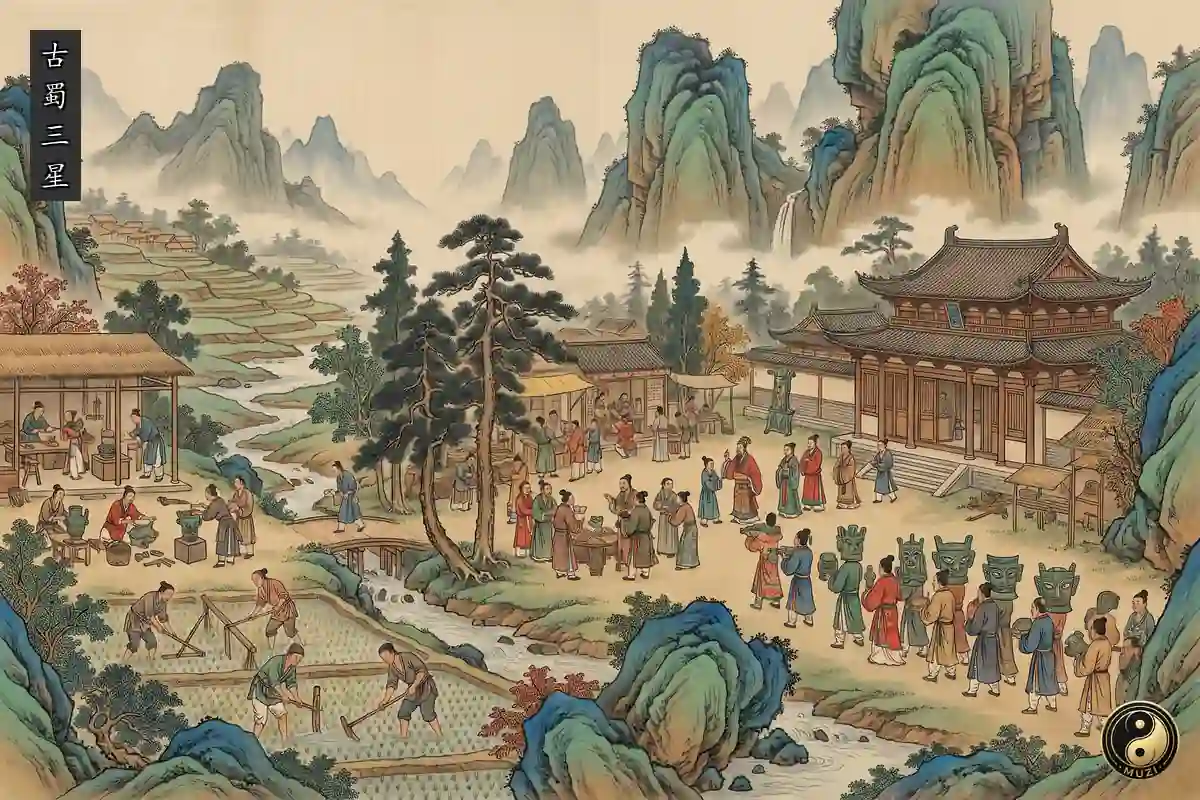


Ancient Shu is met in writing before it is confirmed in the ground. Chang Qu's Huayang guo zhi (Records of the Lands South of Mount Hua) writes: “When Zhou lost its order, Shu was first to take the title of king,” and of Shu in the Zhou age says that “under Zhou, hemmed in by Qin and Ba, though it served the royal duty it could not join the covenants of the Spring and Autumn period”; it also lays out the order of the Shu rulers: “There was the Marquis of Shu, Can Cong, whose eyes protruded, who first took the title of king,” after whose death “a stone coffin and outer chamber were made”; “the king Bo Guan,” “the next king was Yu Fu”; later came Du Yu, who “taught the people farming.” Li Bai's Shu dao nan (The Hard Road to Shu) writes: “Can Cong and Yu Fu, how dim the founding of the state!” and adds: “Forty-eight thousand years since then, and no smoke-trail joined it to the passes of Qin.” These Shu rulers survive only as names in texts; the Huayang guo zhi does not say how they correspond to the present site, and the archaeological reports opened here do not assign the finds to any Shu ruler.
The archaeological material comes from Sanxingdui in the north of the Chengdu plain. China Daily reported in 2025 that the site was “First discovered in the 1920s,” that “The first two pits, unearthed in 1986” were followed by six more from 2019 (pits 3 to 8), and that carbon-14 analysis by Peking University gives “a 95.4 percent probability that the burial of the sacrificial pits No 3, 4, 6, and 8 occurred between 1201 BC and 1012 BC,” a period the report places in the late Shang Dynasty; Ran Honglin of the Sichuan provincial institute says that “Identical fragments found across pits No 1, 2, 3, 4, 7, and 8 suggest that these artifacts were buried at the same time.” Archaeology magazine gives another set of dates, placing two other pits around 1046 to 950 B.C. It writes that the two pits found in 1986 held “hundreds of jade, bronze, and ivory objects that had been ritually disposed of,” and that in one of the newer pits a bronze figurine, kneeling, “carries on its head a ritual vessel called a Zun decorated with a dragon.” According to a joint study by the Sichuan provincial institute, the Palace Museum, the University of Science and Technology Beijing and the Needham Research Institute in Cambridge, Sanxingdui developed a technology “centered on sectional casting, complemented by integral casting and forging”; the researcher Guo Jianbo, speaking of the supports in the casts, says they were “indispensable for casting objects such as the bronze divine tree.”
These finds change how early civilization is told. The South China Morning Post reported in March 2021 that historians and archaeologists believe the discoveries “could shed new light on the mainstream understanding that ancient Chinese civilisation was mostly centred along the Yellow River basin.” What the Sanxingdui pits buried was heavy vessels in quantity. The Zuo zhuan says “the great affairs of a state are sacrifice and war,” and the bronzes, jades and ivory in the pits can be set beside the ritual vessels discussed under Ritual Bronzes and Jade Culture; this is a comparison, not a direct statement of any text. The later fate of Shu is on record: the Shiji says “in the ninth year Sima Cuo attacked Shu and destroyed it,” and the Huayang guo zhi is fuller: “in the autumn of the fifth year of King Shen of Zhou, the Qin grandee Zhang Yi, with Sima Cuo and the commandant Mo and others, attacked Shu by the Stone Ox Road.”
After Shu joined Qin, the plain became a base for Qin and Han in the southwest. The Shiji's Hequ shu (Treatise on Rivers and Canals) writes: “In Shu, the governor Bing cut through the Li Dui, removed the harm of the Mo river, and opened two rivers through Chengdu; these canals all carried boats, and what was left served for irrigation, and the people enjoyed the benefit”; this is the work discussed under Dujiangyan Water Project. The Shiji's biography of the Dayuan records Zhang Qian: “When I was in Daxia I saw bamboo staffs of Qiong and cloth of Shu,” and he proposed “going by way of Shu is direct and has no raiders”; the route from Shu to the west connects with the Silk Road.
Ancient Shu entered cultural memory through legend and verse. The Huayang guo zhi tells the story of the stone oxen: “So he made five stone oxen, and each morning poured gold behind them, saying 'the oxen turn to gold'”; this is a legend, not a record of events. In 2001 a round gold foil with twelve rays and four flying birds was excavated at the Jinsha site in Chengdu; China Daily says it is “known as the emblem of Chinese cultural relics” and says it is “a reflection of the superb gold crafts in use more than 3,000 years ago” and “reveals ancient Shu State people's wisdom.” The finds of Sanxingdui and the gold foil of Jinsha are the two bodies of material evidence from which ancient Shu is discussed today.
Ancient Shu was first a few names in the texts and then heavy vessels in quantity under the ground: the Huayang guo zhi records only Can Cong, Yu Fu and the line that Shu was first to call itself king, yet the sacrificial pits of Sanxingdui held hundreds of jade, bronze and ivory objects, the dating falls around the late Shang, and the casting technology was able to make the bronze divine tree. After Shu joined Qin came the waterworks of Dujiang and the Shu cloth that Zhang Qian saw, and Jinsha yielded its gold foil. The historians and archaeologists reported by the South China Morning Post believe these finds can shed new light on the mainstream view that ancient Chinese civilisation was mostly centred on the Yellow River basin.
Sanxingdui Bronzes is the class in the chapter on Crafts on the bronzes of Sanxingdui, represented by the sacred bronze tree and the protruding-eye masks. It also covers bronze figures and sculpture, including those from outside Sanxingdui. The ancient Shu bronze civilization of Sanxingdui arose on the Chengdu Plain and developed in parallel with the Shang state of the Central Plains, and later the political center of ancient Shu moved to Jinsha in Chengdu. Ritual vessels and other bronzes from outside Sanxingdui belong to Ritual Bronzes.
 Literature
 The Hard Road to Shu
 Zuo Tradition
 Records of the Grand Historian
 People
 Zhang Yi
 Li Bai
 Chang Qu
 Treasures
 Bronze Sacred Tree from Sanxingdui
 History
 Opening of the Silk Road
 Atlas
 Sichuan
 Forbidden City