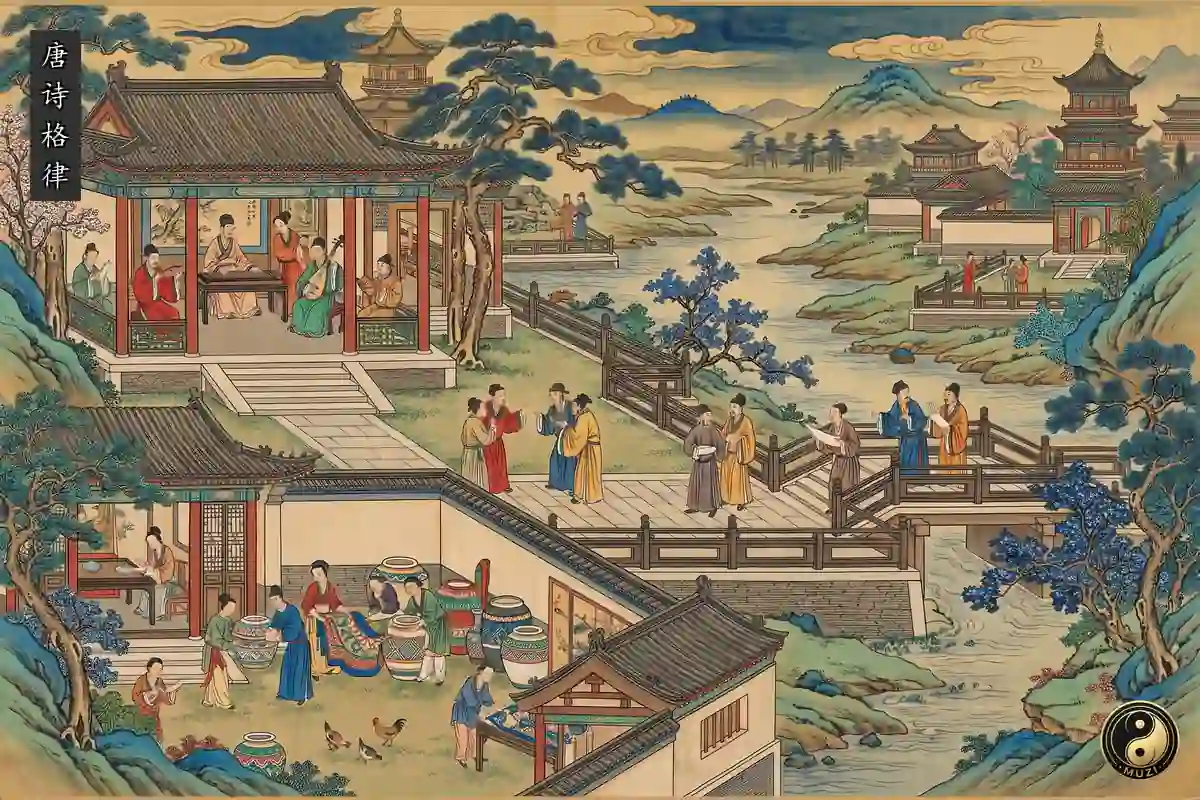
The New Book of Tang, in the Biography of Song Zhiwen, says: "After the Jian'an years of Wei and down to the south of the river, the rules of verse changed many times. With Shen Yue and Yu Xin, sounds and rhymes were drawn together and matching was exact. When it came to Zhiwen and Shen Quanqi, they added ornament, avoided faults of tone, bound the lines and fixed the piece, like a brocade formed into pattern; learners took them as masters and called them 'Shen and Song'." It also quotes a saying: "Su and Li stand before, Shen and Song stand shoulder to shoulder." What this describes is how the tonal rules of the Yongming years (see Rhyme & Couplets) reached Song Zhiwen and Shen Quanqi: they avoided faults of tone, bound the lines and set the measure of the whole poem, and those who studied verse took the two as masters.
Why the rules took hold, the Kangxi Emperor's Imperial Preface to the Complete Tang Poems offers one explanation: "Poetry in the Tang had all its forms and all its methods, so those who speak of poetry must take the men of Tang as the standard, as an archer draws to the full draw and a craftsman works to compass and square. At the founding of the Tang it selected men by tonal rules, gathered the gifted and heroic of the realm to devote themselves to the study of the Six Meanings, and made it their ladder to office." The New Book of Tang, in its Treatise on Selection, records that in the second year of Yonglong (681) Liu Sili, a Vice Director of the Bureau of Merit, said that candidates in the classics largely copied answer notes and candidates for the jinshi only recited old policy responses, so that "all lacked real talent", and an edict ordered that the jinshi be "tested on two miscellaneous compositions, and only those who understood literary rules be examined on policy", which agrees with it. The rules, then, were both a concern of poets and a threshold of the examination hall, which is where Imperial Examinations meets Tang poetry.
How the Tang themselves saw earlier poets, Du Fu left a few lines. "Casual Verses" says: "Writing is a matter for a thousand years, gain and loss are known to the heart. Writers each have their own rank, and fame does not hang down for nothing", and also "I lament that I cannot see the poets of the Sao, the Han way flourished in this", "later men take up old precedent, each age holds its own pure rules", "the method came from the Confucians, the mind from youth worn thin". "Playful Six Quatrains" says: "I do not despise men of today and I love the ancients; pure phrases and fine lines I take as neighbours. I would climb up to match Qu and Song as a yoke-fellow, yet fear to follow in the dust of the Qi and Liang." He treats Qu and Song as predecessors he might drive abreast with, and guards against falling into the dust of the Qi and Liang. Li Bai in "Song on the River" writes "Qu Ping's rhapsodies hang like sun and moon, while only hills remain where the Chu kings' terraces and pavilions stood", a line that runs to Chu Poetry & Li Sao.
The amount of Tang verse that survives is counted in the Complete Tang Poems compiled under the Qing. The preface dated the sixteenth day of the fourth month of the forty-sixth year of Kangxi (1707) says that the compilers "obtained more than 48,900 poems by over 2,200 men, arranged in nine hundred scrolls" and that "the finest of three hundred years of Tang poets has all been gathered into one work". The method of compilation was to "drop the names of early, high, middle and late and arrange everything by period". With such a collection, later readers had a shared text for studying and judging poems.
Later ages did not agree on which Tang verse to follow. Yan Yu in the Canglang Remarks on Poetry, "Discerning Poetry", says: "Discussing poetry is like discussing Chan: poems of the Han, Wei, Jin and High Tang are of the first meaning; poems from the Dali years on are of the lesser vehicle." The History of Ming, in the Biography of Li Mengyang, says Li Mengyang "declared that prose must be Qin and Han, and verse must be High Tang, and he would speak of nothing else". The Kangxi Emperor's preface, however, did not approve of cutting it too finely: "Those who sort the poems of the Tang and cling to early, high, middle and late, dividing them by boundary lines and raising and lowering them without measure, are making names later men forced on it, not a general view." Later in the Qing, the Three Hundred Tang Poems dates to 1763 (the twenty-eighth year of Qianlong), and the preface by Hengtang Tuishi says that when children entered school they were first given the Thousand Family Poems, whose poems were "unsorted for skill or clumsiness", so he "took from Tang poems only those that were on all lips, chose those most needed, a few dozen for each form, three hundred and more in all, and made a single volume as a textbook for family schools, so that children might learn it and grey-haired men not be able to give it up", asked whether it was not "far better than the Thousand Family Poems", and quoted the proverb: "Learn three hundred Tang poems by heart, and even if you cannot write poems you will be able to chant them." This is one example of poetry teaching in Primary Education.
Taken together, these ties run as follows. The Yongming tonal patterns, passed through Shen Yue and Yu Xin to Song Zhiwen and Shen Quanqi, continue Rhyme & Couplets; the selection of candidates by tonal rules and by miscellaneous compositions belongs to Imperial Examinations; Du Fu's "Qu and Song" and Li Bai's "Qu Ping's rhapsodies" lead to Chu Poetry & Li Sao; and the textbook for family schools belongs to Primary Education.
Shen Quanqi and Song Zhiwen "avoided faults of tone, bound the lines and fixed the piece", the jinshi examination tested miscellaneous compositions, the Kangxi Emperor said that those who speak of poetry "must take the men of Tang as the standard", the Complete Tang Poems holds more than 48,900 poems, and Hengtang Tuishi made three hundred and more into a family-school textbook. Du Fu both "would climb up to match Qu and Song" and guarded against "the dust of the Qi and Liang". In the hands of the Tang, meter was a rule, and also a way of learning from the earlier poets and standing beside them.
Poetry covers four-character verse, Chu elegies, Han and Wei yuefu ballads, old-style songs, regulated quatrains, regulated octaves, bamboo-branch songs, palindrome verse, and song lyrics, describing their forms. Ci lyrics, qu verse and drama, rhapsodies, and parallel prose fall outside this category: ci lyrics are covered under Lyrics, qu verse and drama under Qu, and rhapsodies and parallel prose under Rhyme. Poetry commentaries and criticism are covered under Criticism, and the classics under Classics.
 Literature
 Complete Tang Poems
 People
 Yan Yu
 Shen Yue
 Yu Xin
 Song Zhiwen
 Li Bai
 Du Fu