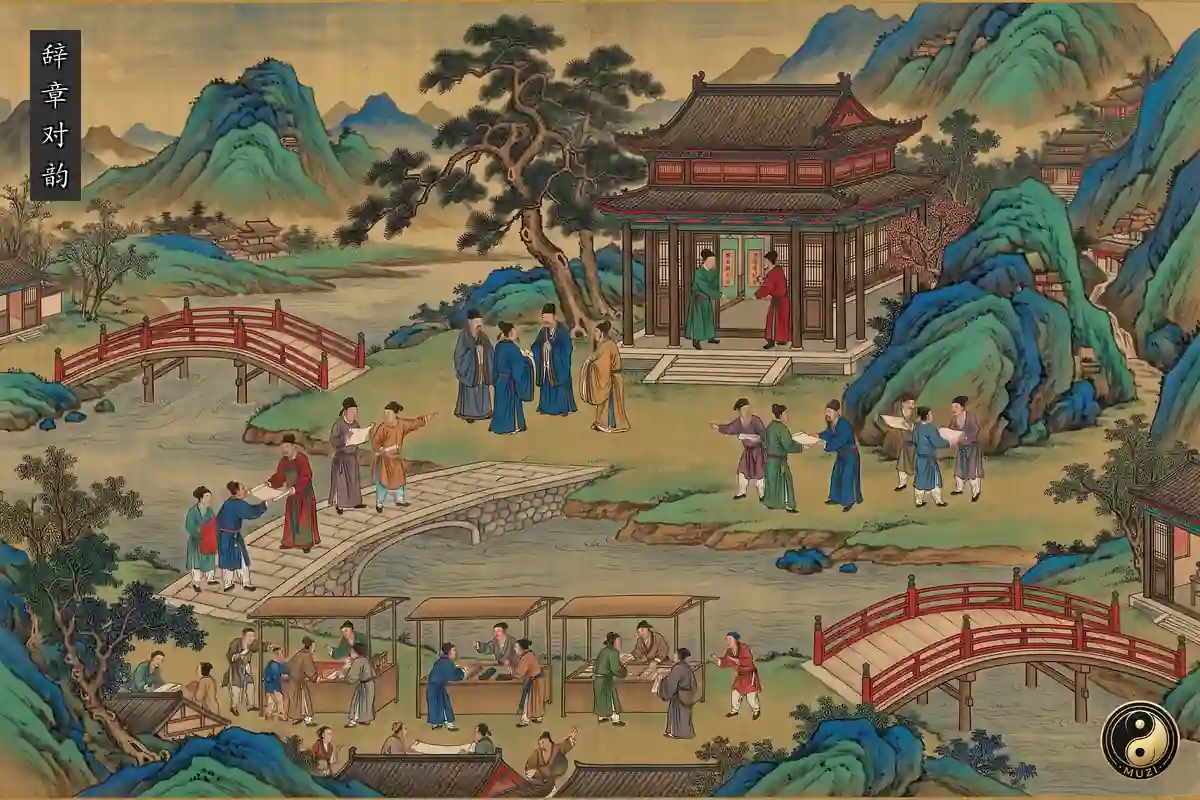
In the Yongming years of the Qi dynasty of the South, tonal pattern became a matter writers attended to. The History of the Southern Dynasties, in the Biography of Lu Jue, says that at that time "writing flourished", that Shen Yue of Wuxing, Xie Tiao of Chenjun and Wang Rong of Langye "promoted one another as men of like spirit", and Zhou Yong of Runan "knew sounds and rhymes well"; the writings of Shen Yue and the others "all used the notes gong and shang, taking the four tones, level, rising, departing and entering, to fix the rhymes, with such faults as level head, upper tail, wasp waist and crane knee", "within five characters the sounds all differ, within two lines the notes jiao and zhi are not the same", and "the world called it the Yongming style". Shen Yue himself wrote in his Discourse on the Biography of Xie Lingyun in the Book of Song: "Let the notes gong and yu alternate, high and low balance one another; if there is a floating sound before, there must be a clipped sound after. Within one slip the sounds and rhymes should all differ; within two lines the light and heavy should all differ."
The demand for balance did not come from tonal pattern alone. Liu Xie in "Paired Phrases" in the Literary Mind and the Carving of Dragons says: "Nature gives shape to things; limbs must come in pairs; the working of spirit leaves no thing alone. When the mind produces writing and weighs a hundred considerations, high and low need each other, and pairs form of themselves." He takes the Changes as an example: "In setting out the four virtues of Qian, line follows line; for dragon and tiger answering by kind, character matches character", and even the words of the age of Yao and Shun were "not made in pursuit of pairing, but simply happened to balance". By his account, from Yang, Ma, Zhang and Cai on they "exalted paired phrases", and by the writers of Wei and Jin, "sentences were cut ever finer, and characters joined to match in meaning". He also divides parallelism into four kinds: "the parallel of words pairs empty phrases; the parallel of facts sets side by side examples of men; the contrasted parallel joins differing principles with a shared meaning; the direct parallel pairs different facts of the same sense."
The rules were disputed from the start. Zhong Rong in the Preface to the Gradings of Poets says: "Now that poems are no longer sung to pipes and strings, what use is there for tonal rules?" He says that Wang Rong, Xie Tiao and Shen Yue sought to be "ever more fine", and so "made writing full of taboos and harmed its natural beauty", and adds: "As for level, rising, departing and entering, I cannot manage them; as for wasp waist and crane knee, the village lanes already have them." His own standard was: "Writing should be fit for chanting aloud and should not stumble; if the clear and the turbid flow freely and the mouth finds it smooth, that is enough." The dispute was about one thing: whether verse and prose should be written by the measure of sound.
How did tonal pattern become a required skill for scholars? The New Book of Tang, in its Treatise on Selection, records that in the second year of Yonglong (681) Liu Sili, an official of the Bureau of Merit, remarked that candidates in the classics largely copied answer notes and candidates for the jinshi degree only recited old policy questions, so that "all lacked real talent"; an edict then ordered that the jinshi be "tested on two miscellaneous compositions, and only those who understood literary rules be examined on policy". The Kangxi Emperor, in his preface to the Complete Tang Poems, also says that "at the founding of the Tang it selected men by tonal rules". Of the Ming eight-legged essay, the History of Ming, Treatise on Selection, says that it "used parallel form". In the Qing, the Draft History of Qing, in the Treatise on Selection, records: "In the twenty-second year an edict cut away old habits and sought practical results, moved the classics essay to the second session, abolished the discourse, memorial and judgment, and added a regulated poem of five-character lines on eight rhymes." The examination hall turned parallelism and tonal pattern into something a candidate had to be able to do.
Parallelism also entered daily life. The History of Song, in the Hereditary House of Shu, records of Meng Chang of Later Shu: "Each New Year's Eve he ordered a scholar to compose words and write them on peach-wood charms to hang on either side of the bedchamber door"; in his last years the words a scholar composed did not please him, "and Chang, thinking them unskilled, took the brush and wrote them himself", with the line "the new year receives surplus blessings", adding that "Long Spring" was the name of the imperial birthday. The History of Song records only that it was written on peach-wood charms and does not call it the beginning of spring couplets. Wang Anshi's "New Year's Day" writes "in thousands of gates and ten thousand doors the sun rises bright" and also "new peach-wood in place of old charms". Che Wanyu's Primer of Tones and Rhymes begins: "Cloud pairs with rain, snow with wind, evening glow with clear sky. Wild goose pairs with swallow going away, nesting bird with singing insect", and within a couplet word is set against word and sound against sound.
Rhyme & Couplets joins other canons. The tonal patterns of the Yongming style were later taken up by Tang poets and written into Tang Poetry Meter. The miscellaneous compositions and regulated poems of the examination hall are linked to Imperial Examinations. The couplets in primers belong to Primary Education. Liu Xie takes the lines of the Changes that explain the Qian hexagram ("setting out the four virtues of Qian") as examples of parallelism, which leads to I Ching Hexagrams. Masters' Prose goes another way: Han Yu in Explaining Study lists the books he draws on, from the Documents on to Zhuangzi, the Sao and the Grand Historian.
Tonal pattern and parallelism are two guides of Chinese writing: Shen Yue wanted "within one slip the sounds and rhymes all differ", Liu Xie said "pairs form of themselves", and Zhong Rong asked "what use is there for tonal rules". Tang candidates for the jinshi were tested on miscellaneous compositions, Qing examinations added poems of five-character lines on eight rhymes, couplets were written on peach-wood charms and in the Primer of Tones and Rhymes' "cloud pairs with rain, snow with wind". The care in setting word against word and sound against sound passed from rules of writing into the daily work of those who read.
Rhyme covers grand Han rhapsodies, short Wei and Jin rhapsodies, Six Dynasties parallel prose, Tang and Song prose rhapsodies, and admonitions, inscriptions, odes, and eulogies, describing tonal patterns and parallelism in these forms. Poems and lyric verse fall outside this category; poems are covered under Poetry, and lyric verse under Lyrics. Other prose is covered under Prose, and sayings and proverbs under Sayings.
 Literature
 Explanation on the Advancement of Learning
 New Year's Day
 Primer of Sound and Rhythm
 Book of Documents
 Complete Tang Poems
 People
 Wang Anshi
 Shen Yue
 Xie Tiao
 Liu Xie
 Zhong Rong
 Han Yu
 Meng Chang
 Che Wanyu
 Zhou Yong