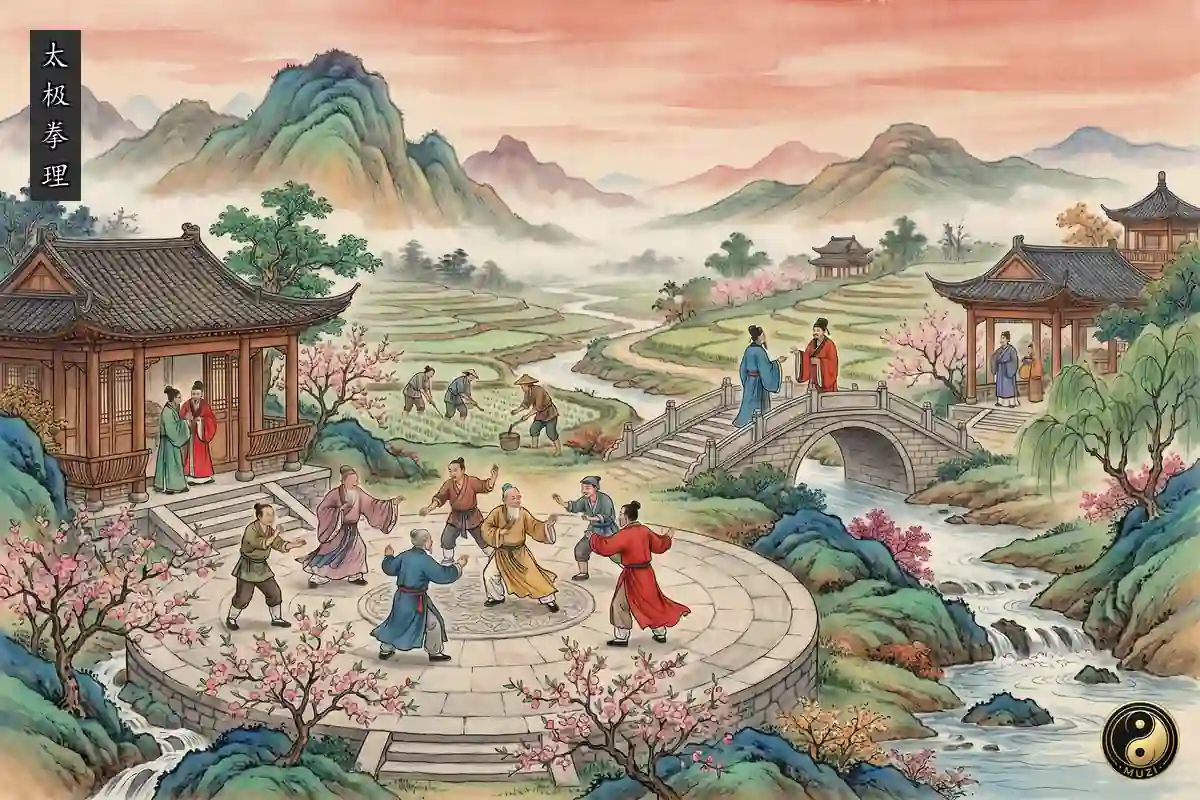
Taijiquan looks soft, but part of its reasoning comes from the books of war. The Sunzi says in its chapter on armed struggle, "set out after the other, arrive before him," and in its chapter on weak and strong points, "in war the way to win is to avoid the solid and strike the empty." The Taiji Quan Jing, headed "Wang Zongyue of Shanyou," carries a Song of Push-Hands that says "when he does not move, I do not move; when he moves a little, I move first," which reads like the same thought set into the arm. The Treatise on Taijiquan adds: "Look at the phrase 'four ounces deflect a thousand pounds' and it is plainly not victory by strength," which closes the road of matching force against force. This is a reading of several passages side by side, not a claim that one borrowed from another.
Where this boxing came from is a matter on which accounts coexist. Huang Zongxi, writing the Epitaph of Wang Zhengnan, says: "The Shaolin are famed throughout the land for their fists, but they set out to strike people, and people can take advantage of that. There is what is called the Inner School, which controls the active with stillness, and whoever attacks it falls at the first touch," and says the Inner School "began with Zhang Sanfeng of the Song"; the text speaks of Inner School boxing, the word taiji does not appear in it, and the line of transmission names Wang Zong, not Wang Zongyue. The theory of Chen Wangting as creator was put forward by the scholar Tang Hao in the early 1930s; another account, looking at the history of how the technique developed, holds that taijiquan comes from the thirty-two-posture long fist in Qi Jiguang's New Treatise on Military Efficiency, passed through cannon fist, and formed as the thirteen postures. Qi Jiguang's own attitude to boxing, in his Essentials of the Boxing Classic, was: "Boxing seems to have no part in the skills of great battle, yet it loosens the hands and feet and trains the limbs, and is the door by which a beginner enters the arts." The official line takes Chen Wangting: Chen-style taijiquan appeared at the end of the Ming and the beginning of the Qing, created by Chen Wangting of Chenjiagou, Wen County, Jiaozuo, Henan, after careful study; taijiquan arose in the mid-seventeenth century in Wen County. With accounts coexisting, no ruling is made here.
Schools multiplied after that. Yongnian Yang-style taijiquan was created by Yang Luchan of Guangfu in the Daoguang years of the Qing; he spent eighteen years away learning and on the basis of the old Chen frame created the one hundred and eight postures; the schools include Chen, Yang, Wu, a second Wu (written with a different character), Sun and He. Today Yang-style practice is spread across Shanghai, Beijing, Sichuan, Xi'an and other places, and in more than eighty countries and regions abroad.
It entered more people's lives. In 2006 Chen-style taijiquan was placed on the first national list of intangible cultural heritage; in 2020 a UNESCO committee decided to inscribe taijiquan on the Representative List of the Intangible Cultural Heritage of Humanity, the nomination having been prepared by Jiaozuo together with seven communities: Chen, He, Yang, Wu, the second Wu, Li and Wang Qihe. It is practised by people of all ages and ethnic groups across the country, has been taken into the formal education system, and the teacher-student bond is set by the baishi ceremony. The manuals themselves also turn its use toward the body: the Song of the Thirteen Postures ends with "what is the final aim of all this thinking? To add to life and extend the years, a spring that does not age," and the Explanation of Taijiquan says "wishing the heroes of the world added years and extended life, and not merely to work at the lesser end of skill." It combines combat, fitness, health, intelligence and the cultivation of character.
Its theory runs through several other canons. The book of war described in Art of War is where the lines read side by side at the start come from. The Treatise on Taijiquan opens: "Taiji is born of wuji, the pivot of movement and stillness, the mother of yin and yang," and the doctrine described in Yin-Yang & Five Elements becomes here the ground of movement and stillness; the Appended Remarks of the Changes (Yi Zhuan, Xici) has "the Changes has the taiji, which gives rise to the two modes, the two modes give rise to the four images, the four images give rise to the eight trigrams," and the trigrams described in I Ching Hexagrams appear in the Explanation of Taijiquan as "these are the eight trigrams" and "advance, retreat, look left, look right, hold the center: these are the five elements," a piece that also calls itself "a remnant discourse of the ancestral master Zhang Sanfeng of Wudang." It was also influenced by Daoist and Confucian thought and by the theory of traditional Chinese medicine; the medical reasoning described in Traditional Medicine is another connection.
What the books of war say of before and after, of solid and empty, was first written on pages about marching and drawing up formations; the boxing manuals put a similar reasoning into push-hands and footwork, so that people who never went to a battlefield can practise it in their own bodies.
The book of war says "set out after the other, arrive before him," the boxing manual says "when he moves a little, I move first": the wording is close, but they speak of two different callings. Who first composed the boxing, Zhang Sanfeng, Chen Wangting or Qi Jiguang, remains three accounts side by side that the records do not settle; what can be seen clearly is what came after: beyond Chenjiagou there was Guangfu in Yongnian, branching into the Chen, Yang, Wu, a second Wu school (written with a different character), Sun and He schools; in 2006 it entered the national list, and in 2020 it was written into the UNESCO list. The manual closes on "add to life, extend the years," and so the reasoning of avoiding the solid to strike the empty came to rest in the bodies of ordinary people.
Tai Chi Principles is the class in the chapter on Strategies on the boxing method. It covers how the military ideas of "moving later yet arriving first" and "avoiding strength to strike weakness" are carried over into the force of the body and into sparring. The common account is that Chen Wangting created taijiquan around the Ming-Qing transition and that Yang Luchan brought it to Beijing in the mid-to-late Qing, where it gave rise to several schools.
 Literature
 New Treatise on Military Efficiency
 People
 Qi Jiguang
 Huang Zongxi
 Zhang Sanfeng (Master Xuanxuan)
 Yang Luchan
 Atlas
 Henan
 Jiaozuo
 Wen County