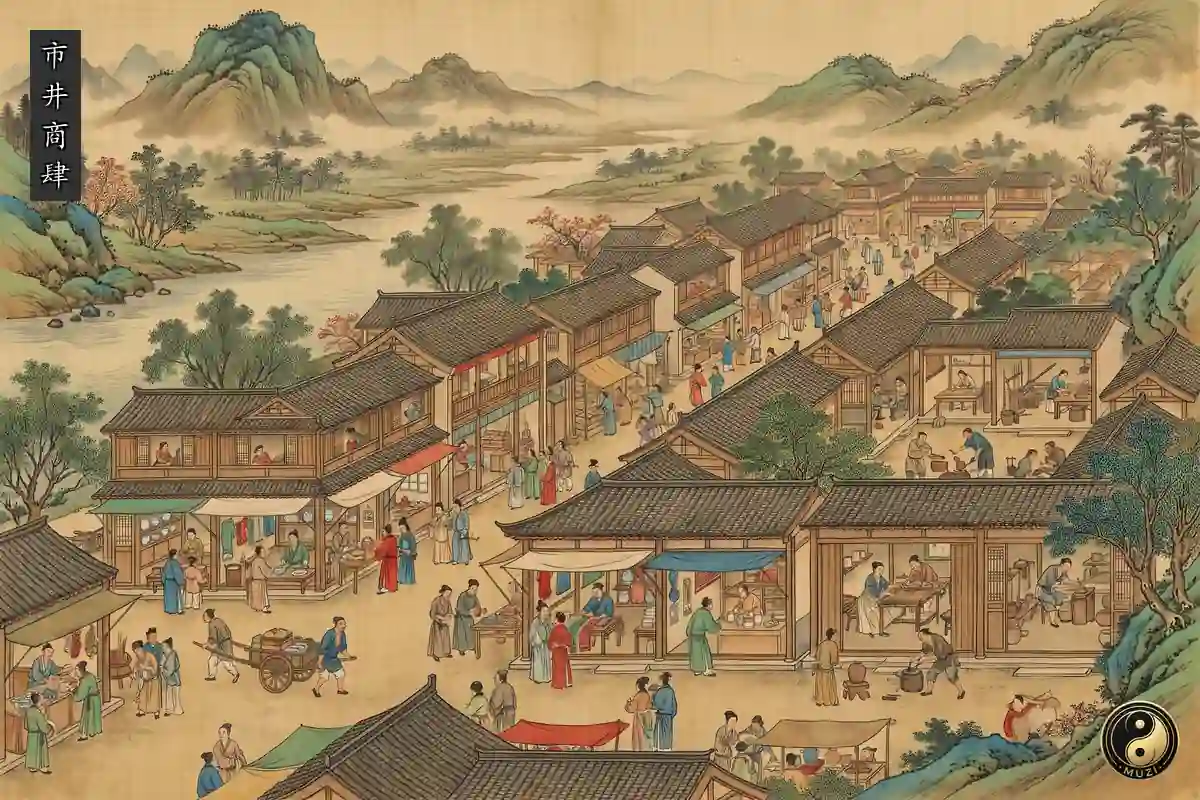
The Tang market had a place and an hour. The Tang huiyao records an edict of Zhenguan 1: "Those of the fifth rank and above must not enter the market." An edict of Jinglong 1 (707): "Outside prefectures and counties no market may be set up. The market shall open at noon with two hundred beats of the drum, when the crowd gathers; before sunset by seven ke, three hundred strokes of the gong, and it disperses." In the same month: "In the markets of the two capitals, a trade that already has a proper shop must not build a side shop in front of it." An edict of the 12th month (lunar) of Kaicheng 5 (840): "The night market of the capital is to be banned." The market was a fixed place, opened and closed by drum, with no extra shop allowed in front.
How the Song changed this is followed here through an article by Wu Gou (first published in The Paper's Sijia lishi column, reposted on the Confucian website on 24 November 2015). He says that after the Song came in, Kaifeng "may no longer have had ward walls; at least along many streets the ward walls had already fallen," residents enlarged their buildings, and encroachment on the streets was serious; as for when the ward-and-market rule was broken, "it is hard to find a fixed point in time." He quotes early Song edicts without naming where they come from: in Qiande 3 (965) an edict that "the capital's night hours, before the third drum, must not stop people on the road"; and in Xianping 5 (1002), after Xie Dequan tore down encroaching buildings, his proposal that "the curfew drums at dusk and dawn all return to the old rule of Chang'an." From Song Minqiu's Chunming tuichao lu he reckons that the street-drum rule of Kaifeng had been officially abolished "by about 1050 at the latest," and he quotes Lu You: "The capital's street drums are now gone; young men reading Tang poems and prose that mention street drums are often at a loss." He writes: "In the time when Zhang Zeduan painted the Qingming scroll, the ward-and-market rule had already wholly collapsed." Whether the night curfew went with it, he sets out both sides: Li Guowen and Kato Shigeshi hold that it was abolished (Kato inferring by Renzong's reign at the latest), Liu Diyu and Li Hequn that it was still in force under Shenzong, and Kubota Kazuo that "even to the end of the Northern Song" it remained. All these views stand.
The Dongjing menghua lu (Dreams of the Splendor of the Eastern Capital) describes the streets of Kaifeng. Juan 2 records that at the Zhouqiao night market the snacks go on "until the third watch," and that one group of them, the goose, duck and offal dishes and eel buns of the Mei and Lu families, cost "no more than fifteen coins each"; it also records a lane running south from Panlou Street "called Jieshen, all of it a place for trading gold, silver and colored silks." Juan 3 records of Maxing Street: "the night market north of Zhouqiao is a hundred times busier, carts and horses crowd so that one cannot stand"; "the night market runs until the third watch ends, and by the fifth watch it opens again. In busy places it goes on through to dawn," and "in winter, even in great wind, snow or rain, there is a night market"; the same juan says that "households in trade often only buy food at the market shops and do not keep vegetables at home."
The Qingming shanghe tu gives another kind of evidence. The Palace Museum's note says "the whole painting can be divided into three sections"; this scroll is by Zhang Zeduan of the Northern Song, ink and light color on silk, showing the area inside and outside the Dongjiaozi Gate of Bianjing and both banks of the Bian River; its last section is the city streets, where "the shops inside the city stand in rows like fish scales, the larger ones with a festive archway at the door, the small ones just an open shed." The Palace Museum's study adds that the thirty-odd scrolls of the same subject, signed Zhang Zeduan or Qiu Ying, are all late Ming or early Qing copies from the Suzhou region and differ greatly from the original.
In the Ming and Qing, shops also opened in the market towns of Jiangnan. Juan 18 of the Xingshi hengyan is a story that begins in the Jiajing years; its narrator writes that in Shengze, a town in Wujiang county, Suzhou prefecture, "the silk and thread brokerages number a thousand or more," and "merchants from the four directions who come to buy swarm like bees and ants"; "a thousand or more" is the story's own phrase, not a count. In an excerpt from Fan Shuzhi's Jiangnan shizhen de zaoqi chengshihua (Beijing Daily, 28 April 2023, reposted by the People's Forum site), he says that in Ming Jiangnan "the commercialization of farm households grew day by day," market towns drove early urbanization, and "finely worked raw silk, silk cloth and cotton cloth sold not only across the country but also far overseas". The abstract of Feng Xianliang's 2005 article points out that whether Ming-Qing market towns belong with cities or with the countryside is the question that "most easily causes dispute," and he urges researchers to "stand on the circumstances of the time and on how people then understood and judged things."
In the Qing bai leichao, shops in the capital and Guangzhou have a rule: when a deal fails, they still "answer with a pleasant face"; when it succeeds, the shop, "as the buyer leaves, always says its thanks," and the book reckons the shopkeeper's thought to be that "even for a one-coin sale one must say thanks." The same book records the capital's "small market," where stalls were set up before dawn without lamps and "few of the goods were genuine, many fake," until the officials banned it; it records that furnace shops "cast only horseshoe silver" and also ran money business, and that "after silver coins came into use, the furnace business declined"; and it records a "buying-and-selling street" east of Fuhai in the Yuanming Garden whose "shop owners were all eunuchs." The market had courtesy and cheating both, and both lived in daily life.
The marketplace connects with other canons too. Grand Canal is linked here by the theme of grain transport: the Dongjing menghua lu writes that the Northern Song Bian River "carried grain from the southeast" and that "public and private alike depended on it," and the Qingming scroll shows both banks of the Bian; the Bian was a Song waterway, not the same stretch of water, and the link is this entry's reading. For Merchant Guild Commerce, the "merchants from the four directions" in the Shengze brokerages are its buyers; for Currency Evolution, the change in silver money shows in the furnace shops of the capital, which "cast only horseshoe silver," until "after silver coins came into use, the furnace business declined."
The Tang market had a fixed place, gathered to the drum and dispersed to the gong; by the Dongjing menghua lu, the night market of Maxing Street "runs until the third watch ends, and by the fifth watch it opens again," and the last section of the Qingming scroll shows "the shops inside the city stand in rows like fish scales." When the change came, Wu Gou says "it is hard to find a fixed point in time," and when the curfew ended is also told differently. The Xingshi hengyan gives the town of Shengze silk brokerages "a thousand or more," while whether a market town counts as city or countryside is, in Feng Xianliang's abstract, the question that "most easily causes dispute." From a market opened by the drum to streets that "go on through to dawn," the change is kept in Tang edicts, the Dongjing menghua lu and one painted scroll.
Marketplace Hubs is the class in the chapter on Commerce on town shops: the street-front shops of towns from the Song on, with a shop at the front and a workshop behind. From the streets of Northern Song Bianjing after the ward walls fell away to the Jiangnan market towns strung along the canals in the Ming and Qing, it is about how shops and market streets arose; individual shops are entered separately.
 Literature
 Record of a Dream of Splendour in the Eastern Capital
 People
 Zhang Zeduan
 Lu You
 Treasures
 Zhang Zeduan, Along the River During the Qingming Festival
 Atlas
 Forbidden City