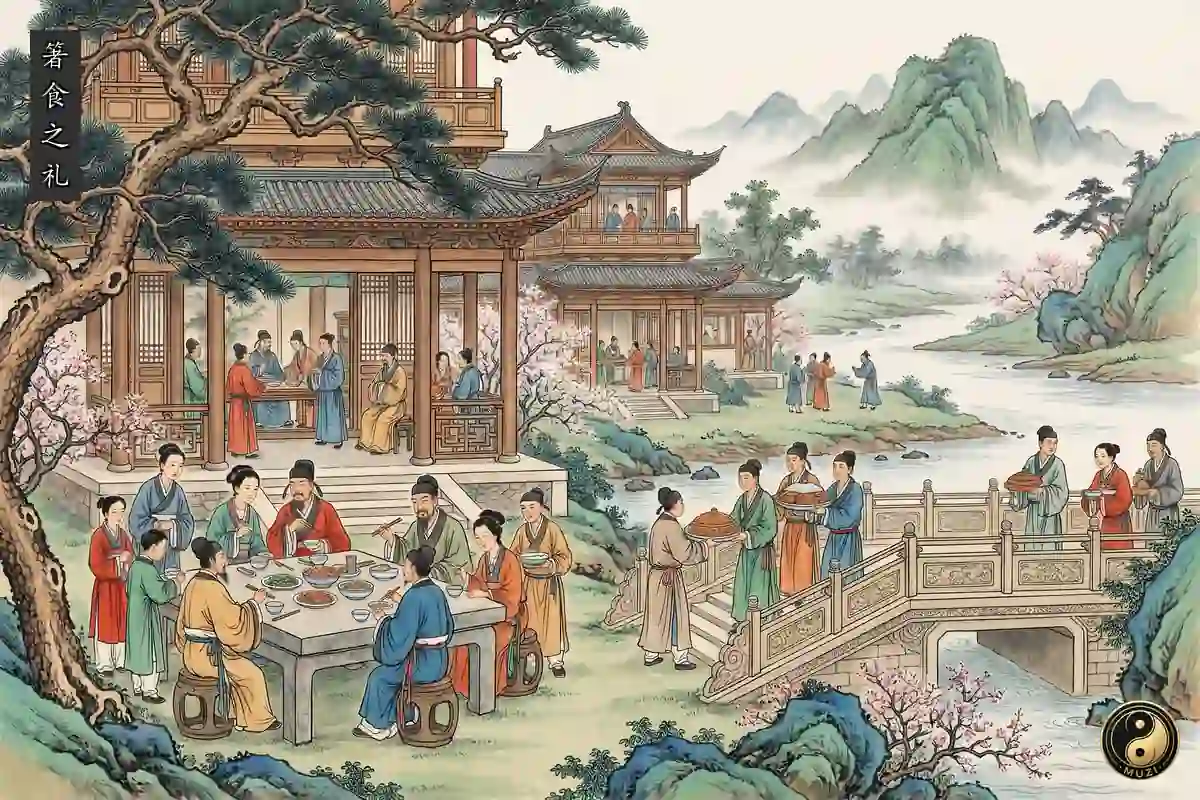
At a round table set with bowls, spoons and chopstick rests in order, a host pours soup from a tureen for a guest and two diners toast, among steamed fish, dumplings, greens and braised tofu.
The use of chopsticks and spoons, separate and shared dining, seating and toasts, and table customs and taboos show how people arrange seats, take food and keep the rules at the table; the dishes and scale of banquets are covered under Banquet Traditions.
1200 BCE · OriginBronze chopsticks from tomb 1005 at Houjiazhuang, Yinxu, Anyang are the earliest known metal chopsticks in China.300 BCE · EvolutionThe Quli chapter of the Book of Rites says 'use chopsticks for broth with vegetables', bringing chopstick use into the code of dining etiquette.1490 · ImpactLu Rong's Shuyuan zaji records that Jiangnan boatmen avoided zhu ('to stop') and called chopsticks kuai'er ('quick ones'), the origin of the modern word kuaizi.
This class is about the rules of eating, in four branches. Chopsticks and spoons concerns how they are used and what is expected; separate and shared dining concerns the two ways of eating, one portion each or sharing dishes round one table; seating and toasts concerns how seats are arranged and the general rules of toasting; and table customs and taboos concerns manners at the meal. Chopsticks and spoons are objects in themselves and belong to the class on articles; the specific drinking games belong under Drinking Customs, and only use and rules are discussed here.
On chopsticks and spoons: the Quli chapter of the Book of Rites calls chopsticks jia, and says that jia is used for broth with vegetables and not for broth without. According to an article from the Guanfu Museum, millet rice is eaten with the spoon and not with chopsticks. On seating: in the Book of Rites seats are arranged by direction and by age, as in "mats facing south or north, with the west as the place of honour", and a man of sixty sits while a man of fifty stands in attendance. On toasting: in the Xiangyinjiu yi chapter of the Book of Rites, the guest toasts the host, the host toasts the assistant guest, the assistant toasts the other guests, and the order follows age.
On table customs: the Quli chapter of the Book of Rites already holds many rules, for example that when dining with an elder and the host serves the food himself, one bows in thanks before eating; one should not press rice into a ball, put leftover rice back in the rice vessel, gulp broth, or smack the lips; when eating with others one should not aim to be full, and should not rub one's hands when sharing rice. On separate and shared dining: in Han banquet pictures people sit on mats and eat from separate tables, one portion each; one view holds that shared-table dining began in the Tang and did not truly develop until the Northern Song, and accounts differ on when the change was complete. In recent years the practice of "one portion each, two serving chopsticks, three bring their own" has been promoted, with serving chopsticks used to share dishes.
Table Etiquette is the class on how people eat in the chapter on the Cuisine. It covers the use of chopsticks and spoons, separate and shared dining, seating and toasts, and general table customs, and shows how people arrange seats, take food and keep the rules at the table; the dishes and scale of banquets are covered under Banquet Traditions.
The utensils, seating and rules of eating came into the record one by one.
Forty-two bone chopsticks, five to six thousand years old, have been found at the Longqiuzhuang site in Gaoyou, Jiangsu, though scholars differ on what they were used for; the six bronze chopsticks from tomb 1005 at Houjiazhuang, Yinxu, in Anyang are the earliest known metal chopsticks in China.
The Quli chapter of the Book of Rites says "use jia for broth with vegetables", bringing the use of chopsticks into the code of dining etiquette. The Han Feizi tells the story of the Shang king Zhou and his ivory chopsticks. In the Book of Rites seats are arranged by direction and age, and the Records of the Grand Historian also gives the seating at the Hongmen banquet by direction: Lord Xiang and Xiang Bo sat facing east, and the Duke of Pei faced north.
In Han banquet pictures people eat from separate tables, one portion each. One view holds that shared-table dining began in the Tang and did not truly develop until the Northern Song, and accounts differ on when the change was complete.
Lu Rong's Shuyuan zaji of the Ming records that Jiangnan boatmen avoided the word zhu ("to stop") and called chopsticks kuai'er ("quick ones"), and from this the name kuaizi became common. The practice of "one portion each, two serving chopsticks, three bring their own", promoted in recent years, uses serving chopsticks to share dishes.
Chopstick Banquet
The banquet at lower left, where diners use chopsticks, is the clearest scene of chopstick etiquette.
Ordered Dishes
The many dishes arranged on the table show the ordered setting of a chopstick meal.
Serving Food
Figures on the right bridge carry trays of food, extending the scene of formal serving and dining.
At a formal banquet, chopsticks rest on holders before each guest as dishes are arranged by protocol and diners take food in turn, the etiquette of the chopstick governing the meal. Dual-utensil kinetics translating leveraging mechanics into strict dining protocols.
Table Etiquette is like a mat spread out on the floor: who sits where and who toasts whom follow an agreed order, and those who sit down follow it, so the meal passes in ease.
Bronze chopsticks were found in tomb 1005 at Houjiazhuang, Yinxu in Anyang; the Quli chapter of the Book of Rites says to use jia for broth with vegetables; and Lu Rong of the Ming records that Jiangnan boatmen avoided the word zhu ("to stop") and called chopsticks kuai'er, from which the name kuaizi became common.
Imagine a young man who has never before attended a banquet with his elders.
On entering he looks at the seats before anything else: the elders sit at the front and he sits down behind them. The host brings the food himself, and the young man rises and bows in thanks before he lifts his chopsticks. When the broth has vegetables he uses jia, and when it has none he does not. He keeps in mind what his elders told him: not to press his rice into a ball, not to gulp the broth, and not to smack his lips.
When the toasts begin, the guest toasts the host first, the host then toasts the assistant guest, and the assistant toasts the other guests in turn, in order of age. He keeps the rules of the feast in mind one by one, and tells his companions of them when he gets back.
In the Book of Rites seats are arranged by direction and age; when dining with an elder and the host serves the food himself, one bows in thanks before eating; the Quli chapter says that jia is used for broth with vegetables, and gives rules such as not pressing rice into a ball, not gulping broth and not smacking the lips; and in the Xiangyinjiu yi chapter the guest toasts the host, the host toasts the assistant guest, the assistant toasts the other guests, and the order follows age. These rules come from different chapters of the Book of Rites and belong to different occasions, and the story puts them into one meal. (This is an illustrative story, not a historical account.)



 Chopsticks and SpoonsHow chopsticks and spoons are held and used, and the rules and taboos of using them.
 Separate and Shared DiningEating from separate portions, and eating from shared dishes around one table.
 Seating and ToastsThe order of places at the table, and the order and manners of toasting.
 Table Customs and TaboosGeneral table manners, and what is avoided at the table.