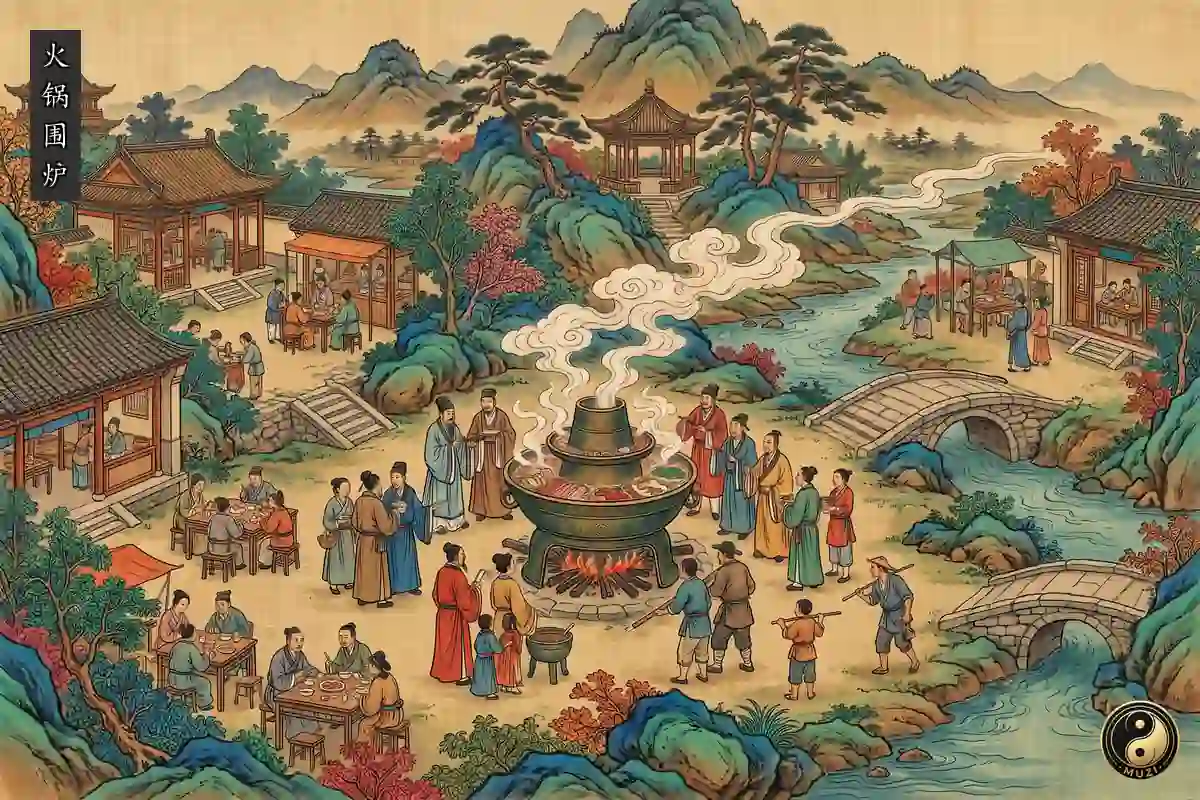
A copper chimney hotpot bubbles over charcoal as diners dip sliced meat, tofu and greens with chopsticks, with plates of raw sliced meat, tripe, fish slices, fish balls, bean-curd skin, shiitake and wood ear, and bowls of dipping sauce.
From Han warming stoves to Qing hotpot, blending meat and vegetables in hot broth, showing the ideal of balanced flavours and a shared ritual around the stove.
59 BCE · OriginA bronze hotpot from the tomb of Liu He, Marquis of Haihun, together with ranlu food warmers, shows that heated communal eating around a stove existed in the Han.1250 · EvolutionLin Hong's Shanjia qinggong of the Southern Song recorded 'boxiagong', rabbit slices swished in boiling broth over a stove, the first written account of hotpot rinsing.1785 · ImpactAt the Qianlong emperor's Banquet of a Thousand Elders in 1785, hotpot took centre stage, and in winter the Qing court served hotpot at every meal.
What marks hotpot is that the heating is brought to the table. A stove and pot stand beside the diners, the broth is brought to the boil, meat and vegetables go in to be cooked on the spot and eaten when done, and everyone gathers round one pot, each reaching in with their own chopsticks. So this class concerns both the broth and ingredients in the pot and the scene of eating together around a stove.
This way of eating divides into different classes by region. The northern swished-meat pot uses a copper pot with a chimney; when the broth boils, very thin slices of mutton are swished in, then dipped in sauce, usually with vegetables on the side. Sichuan-Chongqing hotpot has a beef-tallow base, hot, numbing and savoury, and in it are cooked tripe, duck intestines, sliced meat and many vegetables; diners often mix sesame oil and mashed garlic into an oil dip. Dabianlu is the hotpot of Guangdong and its neighbours, usually with a light base such as a plain-water pot or a fish-bone broth pot, with the stress on fresh ingredients, dipped in garlic and sesame-oil sauce or sand-tea sauce. Warming pots are small hotpots that keep dishes hot at the table, often used at the Qing court and at banquets.
Before hotpot and in its early days there was also a tradition of cooking in a small stove and pot at the table, which this class calls the early dipping-pot tradition. Tombs of the Han have yielded heatable vessels called ranlu, and scholars still differ over whether they held sauce or were used for swishing and boiling food. It is not a dish but a way of eating that spans several periods.
Hotpot Culture is the class for eating around a stove in the chapter on the Cuisine. It is about food cooked and eaten at the table on a stove and pot: from the Han ranlu and the Song boxiagong to the later northern swished-meat pot, Sichuan-Chongqing hotpot, Cantonese dabianlu and warming pots, the methods differ by region, but the people at the table gather round one hot pot and cook as they eat. Vessels such as the ranlu belong to the class on utensils.
To tell of hotpot, one starts with vessels for heating food at the table and comes at last to the hotpots of the different regions, each forming a class of its own.
A bronze hotpot was found in the tomb of Liu He, Marquis of Haihun, of the Western Han. Together with ranlu food warmers it shows that heated communal eating around a stove already existed in the Han. The ranlu is linked to the blending of the five flavours, and scholars still differ over whether it held sauce or was used for swishing and boiling.
Lin Hong's Shanjia qinggong of the Southern Song records boxiagong: rabbit meat cut into thin slices, soaked in wine, sauce and pepper seasoning and then cooked in boiling broth in a small pot on a stove at the table. This put the method of swishing food in broth into writing.
At the Banquet of a Thousand Elders in 1785, the fiftieth year of the Qianlong reign, hotpot took centre stage, with slices of mutton, chicken and roe deer as the main items. From the fifteenth day of the tenth month the Qing court served hotpot at every meal for about three months; the palace had small silver warming pots, and a Qianlong-era menu lists "one hot pot". At the Banquet of a Thousand Elders of 1796, year one of the Jiaqing reign, every table had a hotpot.
Later, the hotpots of the different regions each became a class of their own. As for the origin of Chongqing hotpot, some accounts place it at the end of the Ming and the start of the Qing, and the accounts do not agree on the date.
Han Ranlu
The Han-dynasty court lady at center-bottom with a small charcoal brazier and bronze ran-vessel for warming sauce is the earliest ancestor of hotpot.
Yuan Shabu Pot
The Mongolian horsemen at upper-left shabu thin-sliced mutton inside a steppe yurt, marking the arrival of copper-pot shabu in Central China.
Qing Court Hotpot
The multi-tiered pewter chrysanthemum hotpot and fine porcelain on the rosewood long table show the Qing-era state-ceremonial hotpot.
Chongqing Maodu
The upper-right Chaotianmen dockworkers on a wooden boat cook offal in a great copper pot with heaped chilies and Sichuan pepper, the origin of málà hotpot.
A charcoal-fired hot pot bubbles at the center of a table as diners swish paper-thin meat slices and greens, steam rising above bowls of dipping sauces, capturing the joy of a winter gathering. Rapid boiling vessels blending a hundred ingredients into an interactive social ritual.
Hotpot Culture is like a basin of glowing charcoal on a winter night: people draw in towards the fire, the pot steams in the middle, and whatever is cooked is shared on the spot.
A bronze hotpot was found in the tomb of Liu He, Marquis of Haihun, of the Western Han; Lin Hong's Shanjia qinggong of the Southern Song records boxiagong, rabbit slices swished in boiling broth over a stove; and at the Banquet of a Thousand Elders of 1785, hotpot took centre stage.
On a winter night a family sat down round a table with a small stove in the middle and a pot on the stove.
The grandmother brought the broth to the boil, and the granddaughter carried in the thinly sliced meat. The father picked up a slice, swished it in the broth, lifted it out as soon as the colour changed, dipped it in sauce and said: just right. The granddaughter tried the same but left hers in a little too long, took a bite and said it was a bit tough. The grandmother laughed and said: take your time, and watch the colour.
A neighbour knocked and brought a bunch of greens, and the grandmother said he had come at the right moment, they would all go into the pot. The neighbour sat down too and took up his chopsticks. The broth steamed, and in the small dish before each person the sauce was different.
Hotpot is a way of cooking and eating at the table. Boxiagong in the Southern Song Shanjia qinggong already records meat slices swished in boiling broth, and the northern swished-meat pot, Sichuan-Chongqing hotpot and dabianlu each have their own broth and dips, which diners often mix themselves. The bronze hotpot from the tomb of Liu He, Marquis of Haihun, shows that heated communal eating around a stove existed in the Han. (This is an illustrative story, not a historical account.)




 Early Dipping-Pot TraditionThe early tradition of cooking food in a small pot at the table, from the Han ranlu to the Song bo xia gong.
 Northern Chinese HotpotThe northern hotpot: thin slices of mutton cooked in a copper pot and eaten with a dipping sauce.
 Sichuan-Chongqing HotpotThe Sichuan-Chongqing hotpot: a numbing, hot beef-tallow broth in which tripe, duck intestine and other foods are cooked.
 Cantonese HotpotThe Cantonese hotpot: a light broth in which seafood, sliced meat and vegetables are cooked at the table.
 Charcoal Warming PotsSmall pots that keep food hot at the table, much used at the Qing court and at banquets.