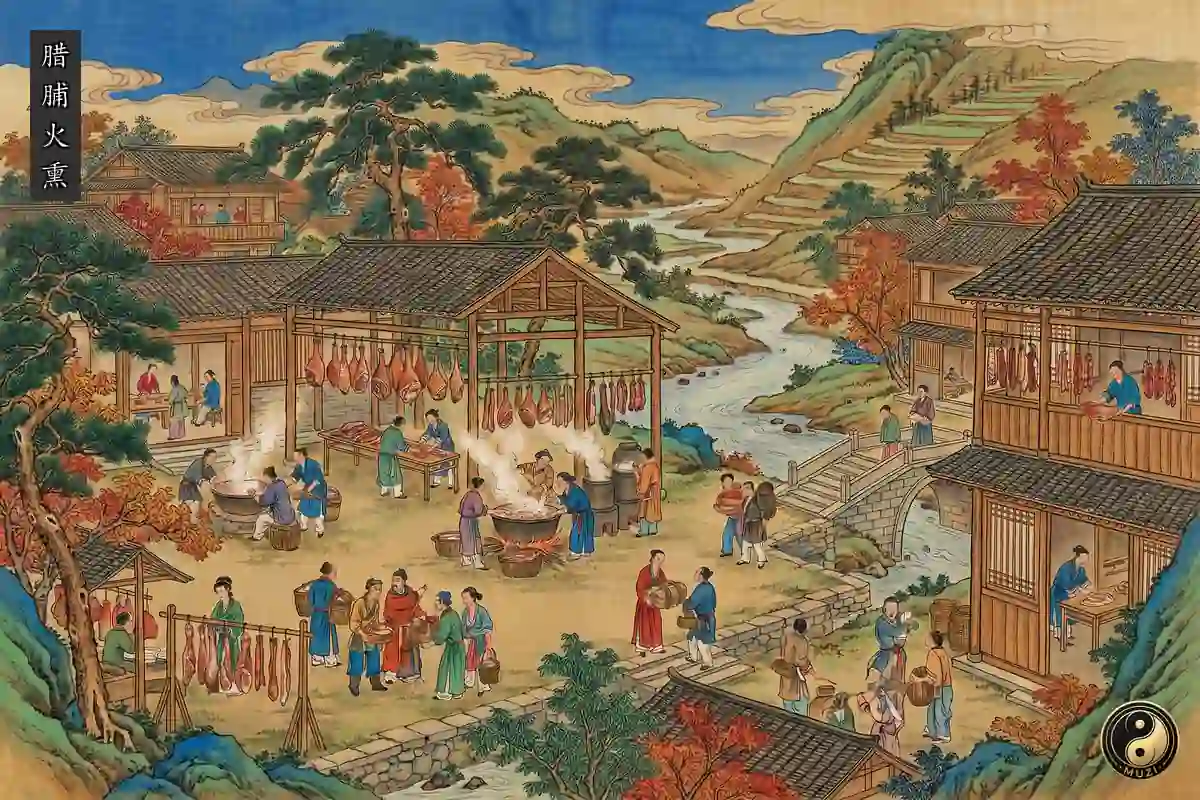
In an autumn hillside village, eaves and wooden racks hang heavy with cured meats and sausages, smokehouses send up smoke and villagers cut and salt meat among red-leaved trees.
Cured Meats
Preserving meats and developing their flavour through salting, air-drying and smoking, an accumulation of food experience along the border of herding and farming and part of festival fare.
Sources (2)
The methods of this class are salting, air-drying and smoking, to make meat and fish keep longer and take on a particular flavour. In smoking, the smoke colours the food and adds fragrance, and it also helps preservation.
Each branch has its own meaning. Ham is made from the hind leg of an animal, mostly the pig, by salting, air-drying and fermenting, and some hams are also smoked; hams are often named for where they are made. Cured pork and sausage are pork products salted, air-dried or smoked in winter; cured pork is called larou because it is cured in the twelfth lunar month, salt leads the curing ingredients, and Guangdong often adds soy sauce, wine and white sugar. Dried jerky is dried meat made by air-drying or drying over heat, and beef jerky is one kind. Smoked foods are chiefly smoked meat, smoked fish and smoked chicken and duck, with firewood, rice and the like commonly used as the smoking material. Salted fish is fish that has been salted, sun-dried or cured.
Styles of cured meat differ from place to place, some saltier, some sweeter, some with a smoky taste: in Guangdong cured pork is mostly air-dried, and in Sichuan, Hunan, Chongqing, Guizhou and Jiangxi it is mostly smoked. One salted fish of Taishan in Guangdong is made by packing fish in layers in coarse salt and then drying them in sun and wind; it is steamed before eating, often with ginger and scallions. One smoked duck of Sanming in Fujian is cured, braised and then smoked over rice.
Braised and sauced cooked meats are meat products cooked and flavoured in sauce or braising broth and ready to eat, such as Dezhou braised chicken and Nanjing salted duck. They are not made mainly by air-drying or smoking, and so form a class of their own.

Cured Meats is the class on cured and preserved meat in the chapter on the Cuisine. It gathers meat and fish kept by salting, air-drying and smoking: ham, cured pork and sausage, dried jerky, smoked foods, and salted fish; braised and sauced cooked meats lie next to it but are not made mainly by drying or smoking, and form a class of their own.
Dried meat appears first in an office of the Zhou, then in ritual, and later in a farming manual.
The Rites of Zhou appointed the laren "to manage dried meat, all the jerky and cured meat of game", making cured meat an official institution. The Rites of Zhou already mention dried meats such as fu and xiu.
Confucius accepted "a bundle of dried meat" as the fee from a student, showing cured meat as a common ritual gift.
The Northern Wei Qimin yaoshu devoted a chapter to salting, air-drying and smoking cured meats. The Recipes from the Garden of Contentment of the Qing already has a dish of ham stewed with yellow-sprout cabbage.
Cured pork takes its name from being cured in the twelfth lunar month, and the taste of the New Year is often linked with it.
A smokehouse: salted pork legs and ribs hang from rafters while pine and cypress branches smoulder below, the white fat turning amber in the curling smoke as cured ham takes form. Dehydration, curing, and smoke preservation transforming meats across ecological frontiers.
In the twelfth lunar month a grandmother took out the meat she had salted a few days before and hung it, strip by strip, from the beam of the kitchen. Her grandson stood on tiptoe and counted: one, two... The grandmother said: if you cannot count them all, do not count; there will be enough for the New Year.
The grandmother added more firewood to the stove and let the smoke drift slowly upward. The smoke curled around the meat, and the colour of the meat slowly deepened.
Some days later the boy came home from school, smelled smoke in the house and ran straight to the kitchen: can we eat it yet? The grandmother said: not yet, let the wind dry it a while longer.
Cured pork is called larou because it is cured in the twelfth lunar month, and salt leads the curing ingredients; in Guangdong cured pork is mostly air-dried, and in Sichuan, Hunan, Chongqing, Guizhou and Jiangxi it is mostly smoked. The Rites of Zhou appointed the laren to manage dried meat, and the Northern Wei Qimin yaoshu devotes a chapter to salting, air-drying and smoking cured meats. (This is an illustrative story, not a historical account.)