


Temple of Heaven Hall
A circular timber masterpiece built without a single nail, utilizing precise pillar grids to map cosmic time and seasonal intervals.
 Winter SolsticeSpring and Autumn period to present
Sources (1)
To understand Temple of Heaven Hall, we first need to see the historical pressure behind it. It was not a decorative cultural label, but a response to problems of order, trust, production, education, politics or shared life. Those problems pushed people to seek more durable ways of living together. This gives the chapter element meaning beyond a single historical moment.
Temple of Heaven Hall is first of all a concrete civilizational mechanism. A circular timber masterpiece built without a single nail, utilizing precise pillar grids to map cosmic time and seasonal intervals. It brings a value, technique or institution out of abstraction and into social organization and lived practice. Through it, the reader can see how an age turns experience into rules and how those rules continue to shape later life.
Temple of Heaven Hall works through repeatable structure. Through learning, imitation, institutionalization and daily use, people turn local experience into a more stable civilizational capacity. This process allows it to cross time and continue shaping later ideas and practices. It makes the chapter not only historical information, but a clue to how civilization accumulates capability. It also helps later readers see why the same element can reappear in different social settings.
Temple of Heaven Hall also shapes different groups of people. Scholars, artisans, families, officials, merchants, soldiers or local communities may all participate in its formation and transmission. Layered bracket clusters representing cosmic configurations directly onto support columns without iron. This is why it can form meaningful links with other chapters. It has its own functional boundary, yet it sends conceptual, institutional or technical echoes outward.
Temple of Heaven Hall is a key node in Chinese civilization. A circular timber masterpiece built without a single nail, utilizing precise pillar grids to map cosmic time and seasonal intervals. Its importance lies not only in naming an idea, but in showing how people, families, social order, and civilizational values connect. It gives the reader a first doorway into the logic of this chapter. Through it, abstract values enter concrete life.
In the eighteenth year of Ming Yongle (1420 CE), the Temple of Heaven was completed simultaneously with the Forbidden City, located in the southern part of Beijing's outer city. Originally named the Altar of Heaven and Earth for combined worship of both, the temple complex covers approximately 273 hectares, nearly four times the area of the Forbidden City, using vast space to symbolize the boundlessness of the heavenly way. In the ninth year of Jiajing (1530), Emperor Shizong Zhu Houcong, following the ancient ritual principle of separate worship of heaven and earth, added the Circular Mound Altar at the southern end specifically for the Winter Solstice heaven worship ceremony, and in 1534 officially renamed the complex the Temple of Heaven. Simultaneously, separate altars were established elsewhere in Beijing: the Altar of Earth in the northern suburb, the Altar of the Sun in the eastern suburb, and the Altar of the Moon in the western suburb.
The Hall of Prayer for Good Harvests stands atop a three tier circular white marble *sumeru* platform. It is a triple eaved, conical roofed, circular timber frame structure approximately 38 meters in total height with a base diameter of approximately 36 meters. The entire building uses not a single iron nail, relying entirely on mortise and tenon joinery and layered bracket sets to support the enormous roof load. The interior 28 large columns are arranged in three concentric rings: the innermost four Dragon Well columns, each 1.17 meters in diameter, are decorated with gilded coiling dragon motifs and symbolize the four seasons. The twelve middle ring golden columns correspond to the twelve months of the year; the twelve outer ring eave columns correspond to the twelve *shichen* (two hour periods) of the day. Four plus twelve plus twelve equals twenty eight, matching the twenty eight lunar mansions (*xiu*) of traditional Chinese astronomy.
The Temple of Heaven complex is arranged along a north south axis. The southernmost structure is the Circular Mound Altar, the central structure is the Imperial Vault of Heaven, and the northernmost is the Hall of Prayer for Good Harvests. The three groups are connected by a 360 meter long, approximately 30 meter wide brick causeway called the Danbi Bridge. The Danbi Bridge gradually rises in elevation from south to north, so that walking along it feels like ascending step by step from the human world into the heavenly court. The Circular Mound Altar is a three tier open air circular stone platform; the number of paving stones, staircase treads, and surrounding balustrade panels all use nine or multiples of nine, as nine is the supreme yang number and the numerical symbol of heaven's highest supremacy. The central stone, called the Heart of Heaven Stone or the Supreme highest Stone, has a remarkable acoustic property: when a person stands on it and speaks, the voice resonates within the surrounding balustrade walls, amplified as if heaven itself is responding.
At dawn on the Winter Solstice, the emperor led civil and military officials from the Forbidden City, proceeding south through Zhengyang Gate along the imperial road to the Temple of Heaven. Three days of ritual fasting were required beforehand: no meat, no adjudication of legal cases, no proximity to women, no music, demonstrating absolute physical and spiritual purity in reverent sincerity toward Heaven. The grand worship ceremony was held at the Circular Mound Altar, where the emperor, wearing blue sacrificial robes and facing north, first performed three kneeling and nine kowtow prostrations before the tablet of Haotian Shangdi (Supreme Deity of Heaven), then sequentially presented jade, silk and sacrificial animals to the spirit tablets of sun, moon, stars, wind, rain, thunder and lightning, praying for favorable weather and abundant harvests in the coming year. The entire ritual was meticulously choreographed by the Court of Imperial Sacrifices, with every kneeling angle, every step's position, and every piece of ritual music precisely rehearsed.
The form of the outer altar wall itself constitutes a cosmological symbol: the northern end is semicircular representing heaven, the southern end is square representing earth, and the whole combines into the traditional cosmological schema of *tian yuan di fang* (heaven is round, earth is square). The altar grounds are densely planted with ancient cypresses, of which over 3,600 survive with ages mostly exceeding 500 years; walking among them under their verdant canopy creates an atmosphere of solemn depth for the sacrificial space. In 1918, the Temple of Heaven was officially opened as a public park, ending nearly 500 years as an imperial restricted area and opening to the citizens of Beijing. In 1998, it was inscribed on the UNESCO World Heritage list under the name Beijing Imperial Sacrificial Altar.
The reason the Temple of Heaven transcends ordinary religious system to possess civilizational historical significance lies precisely in its weaving together of the precise knowledge of astronomical calendrics, the ethical order of Confucian ritual, and the sensory experience of architectural space into one indivisible integrated system. The 28 columns of the Hall of Prayer are not decorative elements but solidified temporal coordinates; the nine tiers of stone slabs on the Circular Mound Altar are not numerical games but solemn reverence for the laws of heaven. With the simplest circular geometry, it carries the internal logic of an agricultural civilization's most devout recognition of and prayer for the operating order of heaven and earth.
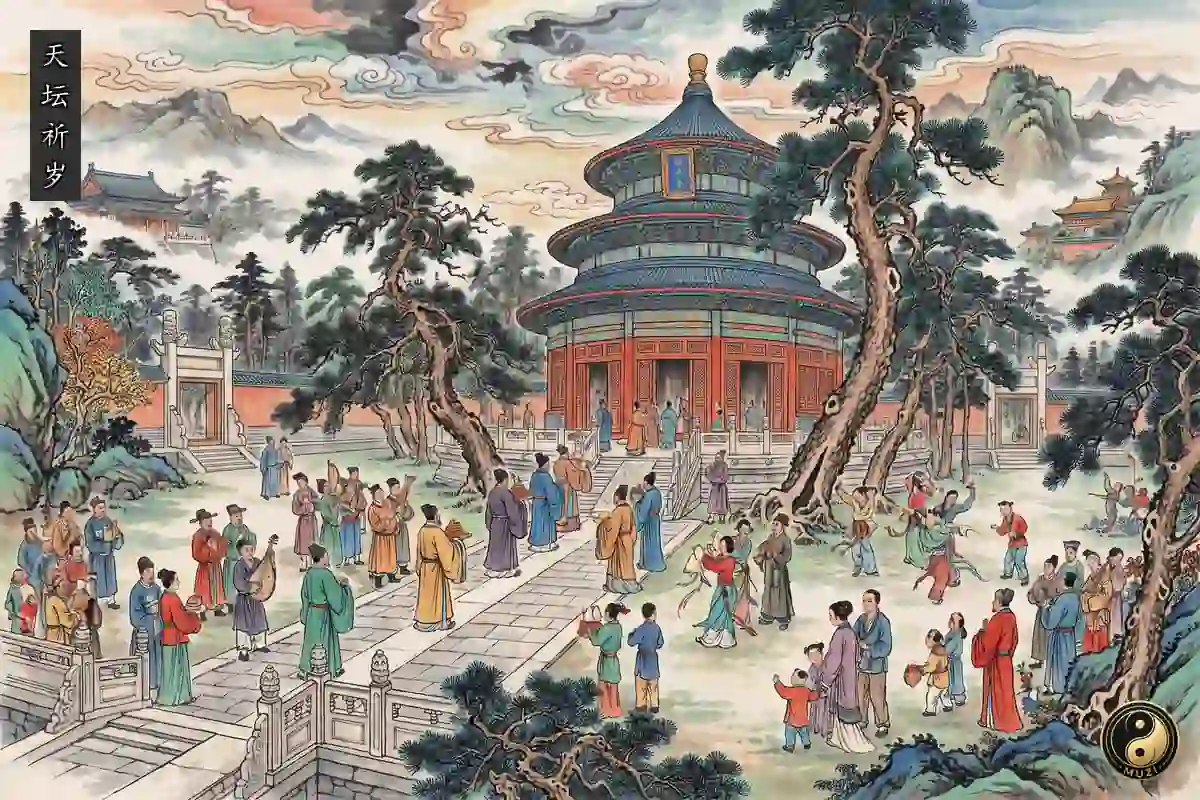
The Hall of Prayer for Good Harvests: a triple-eaved circular timber structure with deep-blue glazed tiles on three marble terraces, its column grid encoding the seasons, nail-free joinery fusing cosmology with construction. Layered bracket clusters mapping cosmic configurations directly onto support columns without iron.
An architect was commissioned to design a temple for heaven-worship. No iron nails, no beams. Entirely wooden.
He chose a circular plan, heaven is round. A conical roof like an open umbrella. Three tiers of eaves, representing three heavens.
Without beams, how? Layered dougong brackets and radiating rafters distributed the roof's weight along a radial skeleton to outer columns. Every column had its position; every bracket its function.
More remarkably, the four central columns represented the four seasons. The inner ring of twelve represented the twelve months. The outer ring of twelve represented the twelve two-hour periods. The columns were not just structure, they were a giant calendar.
The emperor visited, looked up, no beams, no nails, everything held by wood interlocking with wood. He said, This is the proper attitude toward heaven.
Explanation
The Temple of Heaven's Hall of Prayer for Good Harvests is the spiritual pinnacle of Chinese timber architecture. Its circular plan and conical roof symbolize round heaven. No beams, no nails, entirely supported by dougong and mortise-tenon joints. Its column grid astonishes: inner four for seasons, middle twelve for months, outer twelve for hours, together representing the full calendar. The building's structure is itself a model of the cosmos.